
News
Stay up to date on the latest crypto trends with our expert, in-depth coverage.

DeFi Education Fund and other crypto leaders press SEC to lock in DeFi broker guidance
The Block·2026/04/24 15:48
Azerbaijan’s state oil fund sells nearly 22 tonnes of gold in Q1
Kitco·2026/04/24 15:42
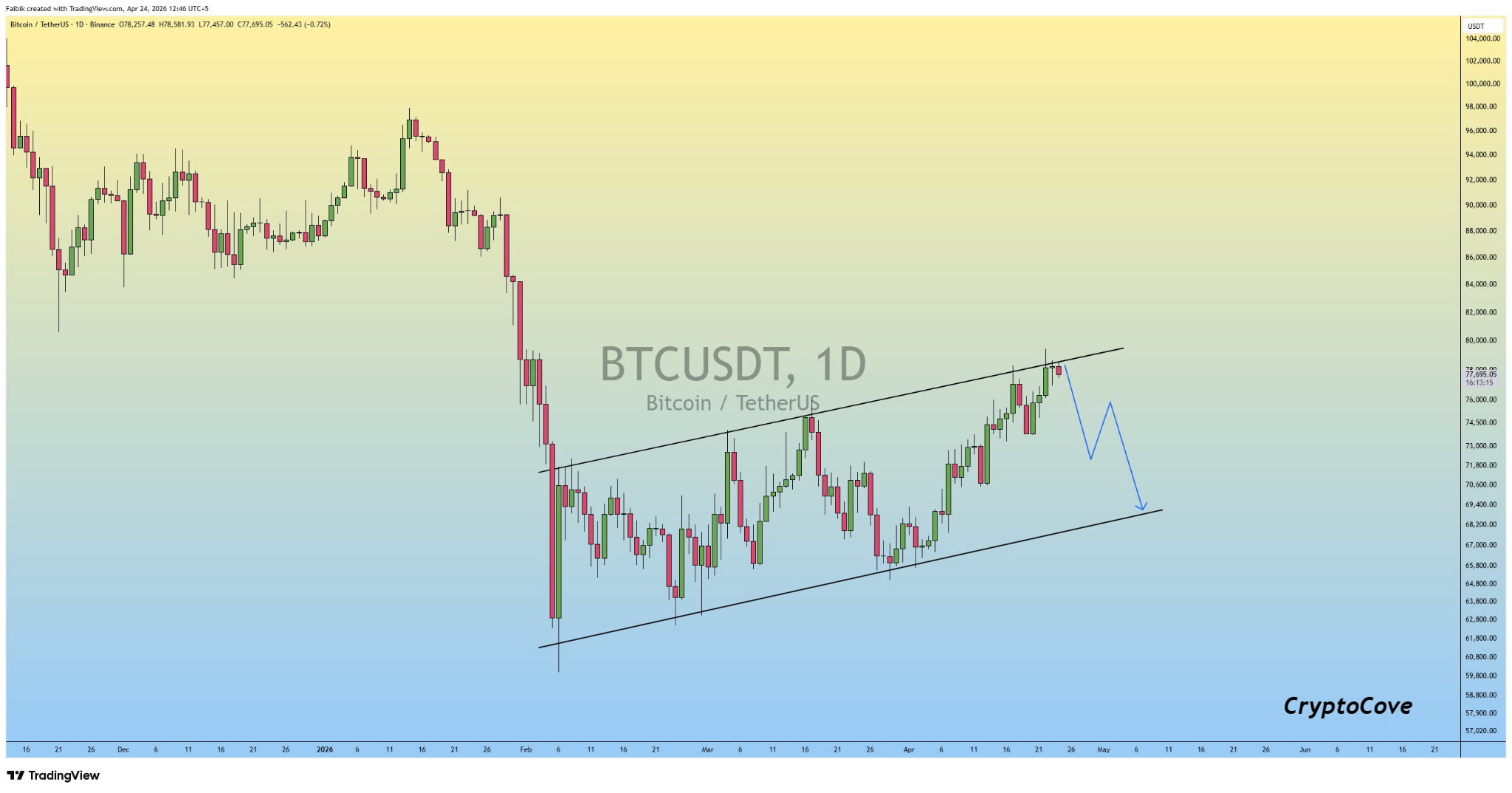
Bitcoin Bulls Defend Trend While $2 Billion Inflows Fuel $85K Outlook
CoinEdition·2026/04/24 15:36
Robin Markets raises $475,000 as VC backs Polymarket yield infrastructure
Crypto.News·2026/04/24 15:36
Google Gemini Predicts XRP Price for May 1, 2026
TimesTabloid·2026/04/24 15:33
Polymarket odds for Waller Fed chair confirmation surge on Powell probe U-turn
Crypto.News·2026/04/24 15:27
XRP jumps to $1.38 as Rakuten enables millions in payments
Cointurk·2026/04/24 15:21
Hotcoin Research|再质押高收益泡沫破裂?从 Kelp DAO 被盗事件看 LRT 系统性风险
Hotcoin 研究院·2026/04/24 15:16
AMZN losing short term steam & needs pullback.
TradingView·2026/04/24 15:15
META — testing MA200 after trendline break
TradingView·2026/04/24 15:15
Flash
14:46
Nasdaq 100 index futures fall over 1%, while Dow Jones and S&P 500 index futures show mixed performanceNasdaq 100 index futures fell by more than 1%, Dow Jones index futures rose by 0.62%, and S&P 500 index futures rose by 0.01%.
14:46
BIS Warns Stablecoins Could Undermine Global Financial Stability • The BIS says stablecoins risk fragmenting the global financial system. • Officials warn dollar-backed tokens could weaken monetary sovereignty. • The institution is promoting Project Agorá as an alternative framework.
The Bank for International Settlements (BIS) has intensified its criticism of private stablecoins, warning they could fragment the global monetary system and create new risks for financial stability. In the 2026 Annual Economic Report, the institution argues that privately issued digital currencies cannot deliver the core characteristics of sovereign money and instead promotes a unified tokenized payment infrastructure built around central banks and regulated commercial banks.
BIS Questions Stablecoins’ Ability to Function as Money
The Basel-based institution argues that stablecoins fail to satisfy one of the fundamental characteristics of modern monetary systems: the “singleness of money.”
Under today’s financial system, one unit of sovereign currency maintains the same value regardless of whether it is held as central bank money, a commercial bank deposit or physical cash. According to the BIS, privately issued stablecoins cannot consistently guarantee that property because they can trade above or below their intended peg during periods of market stress.
The report notes that stablecoins operate across multiple public blockchains that are often isolated from one another. Rather than creating a unified payment network, this structure results in separate digital ecosystems, or what the BIS describes as “walled gardens,” where liquidity, users and applications remain fragmented across competing ledgers.
Officials argue that this lack of interoperability limits competition, reduces payment efficiency and complicates cross-border settlement.
The BIS also warns that large-scale stablecoin redemptions could force issuers to liquidate reserve assets, including U.S. Treasury bills, creating broader stress in traditional money markets through rapid asset sales during periods of financial instability.
Dollar-Backed Tokens Raise Sovereignty Concerns
Another major concern highlighted in the report is the growing adoption of U.S. dollar-backed stablecoins in emerging and developing economies.
The BIS notes that households and businesses in countries experiencing high inflation or volatile domestic currencies increasingly use dollar-pegged stablecoins to preserve purchasing power and facilitate international transactions.
While the trend may offer short-term financial benefits for users, the institution argues that widespread adoption could reduce the effectiveness of domestic monetary policy by shifting savings and payments away from local currencies.
According to the report, continued expansion of dollar-backed stablecoins could accelerate digital dollarisation, reshape international capital flows and increase exchange-rate volatility, ultimately weakening central banks’ ability to manage inflation and support economic stability.
Project Agorá Offers a Different Model
Rather than opposing tokenization itself, the BIS advocates integrating blockchain technology into the existing financial system through Project Agorá.
The initiative brings together eight central banks and more than 40 regulated commercial financial institutions to develop a unified ledger capable of supporting programmable payments and continuous cross-border settlement.
Under the proposed framework, tokenized central bank reserves would serve as the settlement foundation, while commercial banks would issue tokenized deposits that remain fully interchangeable with sovereign money.
The BIS argues this structure preserves the existing two-tier banking system while delivering many of the technological benefits associated with blockchain, including faster settlement, programmability and 24-hour transaction processing.
Unlike privately issued stablecoins circulating across separate public blockchains, the unified ledger is designed to provide a common settlement infrastructure where different financial institutions can transact seamlessly.
Regulators Call for Coordinated Global Rules
The report arrives alongside renewed calls for international regulatory coordination.
Earlier this week, the BIS Financial Stability Institute urged policymakers to accelerate work on common global standards for stablecoins, warning that fragmented national regulations could encourage regulatory arbitrage and deepen financial fragmentation.
The institution argues that inconsistent legal frameworks would make cross-border supervision more difficult while allowing stablecoin issuers to operate under different regulatory standards across jurisdictions.
The report underscores a growing divide in global policymaking. While jurisdictions including the United States have embraced regulated private stablecoins as part of their digital asset strategies, the BIS continues advocating tokenized commercial bank deposits backed by central bank money as the foundation of future digital payments.
As governments increasingly define the next generation of financial infrastructure, the debate is expanding beyond technology to encompass broader questions of monetary sovereignty, systemic stability and who should ultimately control the issuance of digital money.
14:40
Tesla's decline widens to nearly 6.2%, trading at $398.76In the Nasdaq 100 Index constituents, KLA is currently down 7.27%, SanDisk is down 6.54%, Lam Research is down 6.33%, Teradyne is down 6.21%, with Tesla following closely behind.