
News
Stay up to date on the latest crypto trends with our expert, in-depth coverage.

1The biggest gamble in maritime history! $7 billion "stockpiled" supertankers before the US-Iran war, and this Korean tycoon made a fortune2Korean Won launches 24-hour trading: Financial breakthrough and liquidity test under exchange rate pressure3US Market Shift: From "Compute" to "Storage," Up 764% in 6 Months! S&P 500 Top 10 Revealed: AI Storage Chain Dominates, Q2 Hits 4-Year High.

Play-to-Earn Games and DeFi Fuel TON Blockchain’s Rise
Coinedition·2024/06/17 17:55

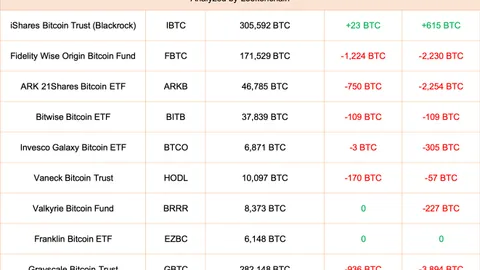
Bitcoin ETFs See $600 Million Exodus as Fed Takes Hawkish Turn
Coinedition·2024/06/17 17:55

Bitcoin (BTC) Price Falls, Yet New Whales Continue to Accumulate
BeInCrypto·2024/06/17 17:07

MicroStrategy to expand Bitcoin stash with $500 million convertible notes offering
Cryptobriefing·2024/06/17 16:49

Retik Finance (RETIK): Best New Crypto to Buy This Week
Newscrypto·2024/06/17 15:49

Is an Altcoin Season Far From Sight? Analysts Weigh In
Newscrypto·2024/06/17 15:49

Bitcoin Down 6% Amid Active Addresses Hitting Five-Year Low
Newscrypto·2024/06/17 15:49

Notcoin (NOT) Faces 11% Decline Post-Airdrop
Newscrypto·2024/06/17 15:49

Flash
22:32
State Street Global Advisors: Structural tailwinds may offset tactical headwinds, gold price could rise to $5,500 by Q1 20271. State Street Global Advisors pointed out in its latest "Monthly Gold Monitoring Report" that although short-term factors such as high yields, a strong US dollar, and the threat of Federal Reserve rate hikes pose pressures, structural supports such as Asian central bank demand and diversification under high stock-bond correlation are expected to drive gold prices up to $5,500 per ounce by March 2027.2. On the tactical level, gold faces significant opportunity cost and US dollar pressure in June. Spot gold fell 11.7% this month, repeatedly testing the $4,000 support level; silver dropped 22.2%, and commodities fell 9.2%. US-listed gold ETFs saw approximately $5.3 billion in outflows this month, after relatively balanced flows in April and May. Market expectations have shifted from 2-3 rate cuts in February to approximately 1.5 rate hikes now.3. On the structural tailwind side, global debt is expected to rise to $353 trillion in the first half of 2026, with government debt ratios approaching historical highs. Proactive fiscal policies and inflation shocks will continue to support gold’s monetary hedging demand. Stock-bond correlation remains above historical norms, raising the importance of gold as a portfolio diversification tool. The allocation of global gold in managed funds and ETF assets is still below 1%, much lower than the strategic allocation range of 3-10%.4. On the physical demand side, Chinese retail investors and emerging market central banks maintain strong demand for gold. Since the Iran conflict, Chinese retail imports have surged and local premiums have risen, indicating a tight domestic supply-demand balance. State Street believes that a hawkish shift from the Federal Reserve will not change the medium and long-term structural logic for gold.5. State Street provides three scenario forecasts: in the baseline scenario (70% probability), gold prices will be in the range of $4,750 to $5,500 over the next 6-9 months; if tactical headwinds persist (25% probability), gold prices may consolidate between $4,000 and $4,750; in the bullish scenario (5% probability), gold prices could rise to $5,500 to $6,250. There is strong support between $3,750 and $4,000, while the probability of achieving $5,500 to $6,250 is lower once the macro environment changes.
22:30
Spot silver rose 1.01% intraday to $63.01 per ounce; COMEX silver futures main contract is quoted at $60.40 per ounce, down 0.19% intraday.Spot silver rose by 1.01% intraday, quoted at $63.01 per ounce; COMEX silver futures main contract last quoted at $60.40 per ounce, down 0.19% on the day;
22:07
The Korean won strengthened slightly on the first day of implementing 24-hour trading.```htmlGolden Ten Data reported on July 6 that the Korean won strengthened slightly against the US dollar on its first day of 24-hour full-day trading. The launch of the 24-hour trading mechanism is a major move by the South Korean government to improve channels for overseas investors to enter the local market and to seek inclusion in the MSCI developed market index. This reform also reflects that the South Korean economy has gradually shifted towards more overseas investment, making it increasingly unreasonable to restrict trading of the won to local market hours. Last week, the won dropped to its weakest level since 2009. South Korean Vice Finance Minister Moon Ji-seong stated last Friday that regulators would strengthen monitoring of night session trading before the official implementation of 24-hour trading on Monday. The won is one of the weakest-performing currencies in Asia this year. The Iran war has pushed up energy prices, and overseas investors selling local stocks after a sharp rally in the South Korean stock market to rebalance their portfolios have both added pressure on the won.```
News