
All 39 US software companies wiped out!

Since 2026 until now,39 US-listed SaaS companies have all plummeted with no exception.
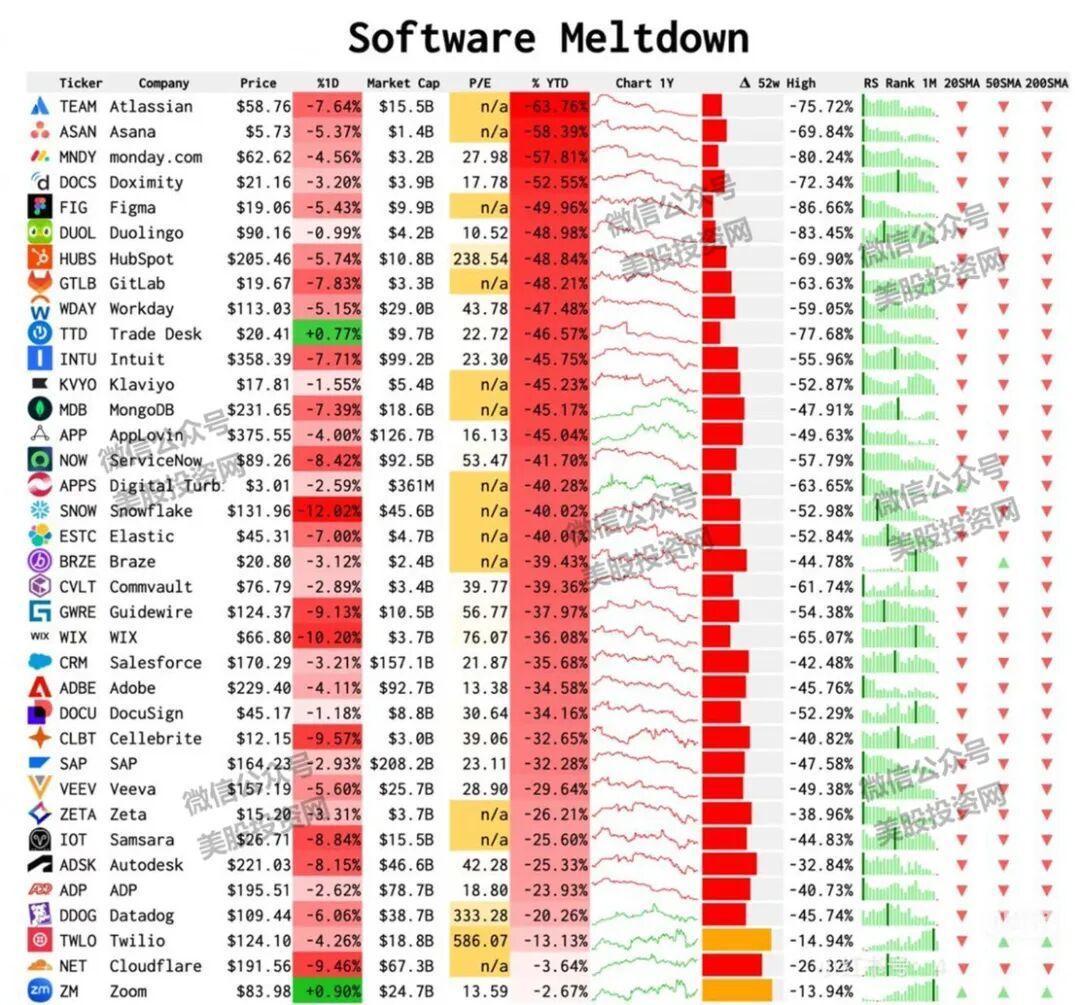
The data in this chart vividly illustrates the drastic downturn of the SaaS industry. The massive drop since the beginning of the year in project management giants like Atlassian(-63.76%), Asana (-58.39%), and Monday.com (-57.81%) is particularly striking.
The US Stock Investing Network’s point that “AI Agent is devouring traditional project management tools” does capture a very real and aggressive shift currently ongoing in the tech sector.
AI ’s Threat to Traditional SaaS Companies
The core value of traditional project management—manual tracking, status updates, and dragging Kanban cards—is exactly whatAI Agent was designed to automate.
As autonomous agents gradually gain the ability to read emails, chat logs, and code commits, and update project status and assign tasks in real time, traditional manually operated tools charging “per-seat” are facing a truly existential threat.
The market, driven by this concern, is aggressively repricing these companies: their core workflows could very soon be commoditized byAI .
A Bigger Reality: It’s Not JustAI
However, although the AI narrative is a major catalyst, to explain the sector’s “collapse” solely by this would be oversimplified. Declines of this magnitude are typically the result of a combination of several severe factors:
1) Valuations returning to reality
Many SaaS companies traded at sky-high price-to-sales (PS) ratios during the high-growth period. The current chart largely reflects the painful “mean reversion” process—the market is no longer willing to pay a premium for growth that does not lead to quick profitability.
2) Enterprise Seat Contraction (Seat Contraction)
Major enterprises are strictly auditing IT budgets:
Large-scale cleanup of software tools
Deduplication and feature consolidation
Cutting down the number of SaaS accounts
This trend had actually begun even before AImatured.
3) A Results-Oriented Market Environment
Today’s investors are very impatient with “traditionalSaaS.”
If a company cannot prove that:
It’s not just “adding a bit of AIfunctionality”
But can truly transform into anAI-first platform
without sacrificing profit margins
Then the market’s response is usually: sell first, explanations can wait.
Which ones did you buy?





Disclaimer: The content of this article solely reflects the author's opinion and does not represent the platform in any capacity. This article is not intended to serve as a reference for making investment decisions.
You may also like
Dash Price Prediction: DASH Rebounds as Buying Pressure Pushes Toward $58

US Stock IPO Preview | 3D Vision Technology Enters Embodied Intelligence, What Is the Growth Potential of Sensing4D AI?
The core competitiveness of Sensing4D AI mainly revolves around three-dimensional vision technology and its applications. Centered on the Sen-3D platform, the company offers comprehensive 3D solutions driven by AI, including 3D reconstruction and digital twins, aiming to bridge fundamental technology research and specific industry applications.
Peers Withdraw IPO Plans Collectively, Anthropic Ventures Solo into Mid-November Window: $1.5 Trillion Valuation Faces Major Liquidity Test
Due to the impact of macro interest rates and the postponement or withdrawal of IPOs by peer companies, the wave of tech listings in the U.S. stock market this fall has nearly disappeared. Anthropic has become the only AI giant to stick to its scheduled listing, planning to release its public prospectus by the end of October, directly facing strict tests of institutional subscription and market liquidity with a potential valuation as high as $1.5 trillion.
Indian Rupee wipes out weekly gains as oil prices continue to rise
Crypto prices
More


