
After a 4.5% plunge, the risk of being bearish on gold is now much greater than being bullish.

FX168 Financial News, December 30—— On Tuesday (December 30), the spot gold market stabilized and rebounded during the Asian session, with prices once reaching $4,380 per ounce and currently trading near $4,375, up about 1% on the day. This move is a technical rebound following the historic plunge in the previous trading session. The sharp volatility occurred against the backdrop of thin year-end trading, where low liquidity amplified price swings, but the deeper market logic is shifting from pure speculative frenzy toward a re-confirmation of long-term structural support.
On Tuesday (December 30), the spot gold market stabilized and rebounded during the Asian session, with prices once reaching $4,380 per ounce and currently trading near $4,375, up about 1% on the day. This move is a technical rebound following the historic plunge in the previous trading session. On Monday, gold prices fell sharply from a record high of $4,549.71 by more than 4.5%, marking the largest single-day drop since October 21, with the lowest point near the $4,300 mark. The sharp volatility occurred against the backdrop of thin year-end trading, where low liquidity amplified price swings, but the deeper market logic is shifting from pure speculative frenzy toward a re-confirmation of long-term structural support.
Fundamental Analysis: Mixed Bullish and Bearish Factors, Long-Term Logic Intact
The current gold market is in a stage where long-term bullish factors and short-term bearish disturbances are contending with each other.
Firstly, monetary policy expectations form the most fundamental support for gold. It is widely expected that the Federal Reserve will enter a rate-cutting cycle by 2026. Although well-known interest rate monitoring tools indicate that the probability of an immediate rate cut in the near term (such as January next year) is not high, expectations for at least two rate cuts within next year remain solid. In an environment of low or even falling interest rates, the opportunity cost of holding the non-yielding asset gold is significantly reduced, which is a long-term positive for gold prices.
Secondly, geopolitical risk premiums persist. Recently, new twists have emerged in the Russia-Ukraine situation, intensifying regional tensions and continuously fueling market safe-haven demand. Such geopolitical uncertainties are a normalized factor supporting gold's role as the ultimate safe-haven asset.
Finally, a profound structural shift is underway. Since 2022, central banks in many countries have been increasing their gold holdings to diversify foreign exchange reserves. This buying is driven by national strategy rather than short-term price fluctuations, providing the gold market with a solid and lasting source of buying power. At the same time, the global investment community's rethinking of the traditional 60/40 stock-bond portfolio model has prompted some institutions to include hard assets such as gold in their core allocation, strategically altering the demand structure for gold.
However, the short-term market also faces some specific pressures. The Chicago Mercantile Exchange (CME) has recently raised margin requirements for gold and silver futures, directly increasing traders' holding costs and triggering large-scale technical profit-taking and position adjustments, which was the most direct catalyst for Monday's plunge. In addition, at year-end, traders at European and American institutions gradually enter holiday mode, resulting in lower market liquidity, which in itself can easily cause unusually sharp price swings. Some well-known commodity indices plan to adjust constituent weights at the beginning of next year, which may prompt some index-tracking funds to conduct passive rebalancing, bringing additional selling pressure.
From a market sentiment perspective, after a series of sharp increases, gold's Relative Strength Index (RSI) has entered a severely overbought zone, and the need for a technical correction has been highly accumulated. Any slight disturbance may trigger concentrated profit-taking.
Technical Analysis: Key Support Area Tested, Short-Term Range-Bound Consolidation
Combining current 240-minute chart technical indicators, the market state can be clearly positioned.
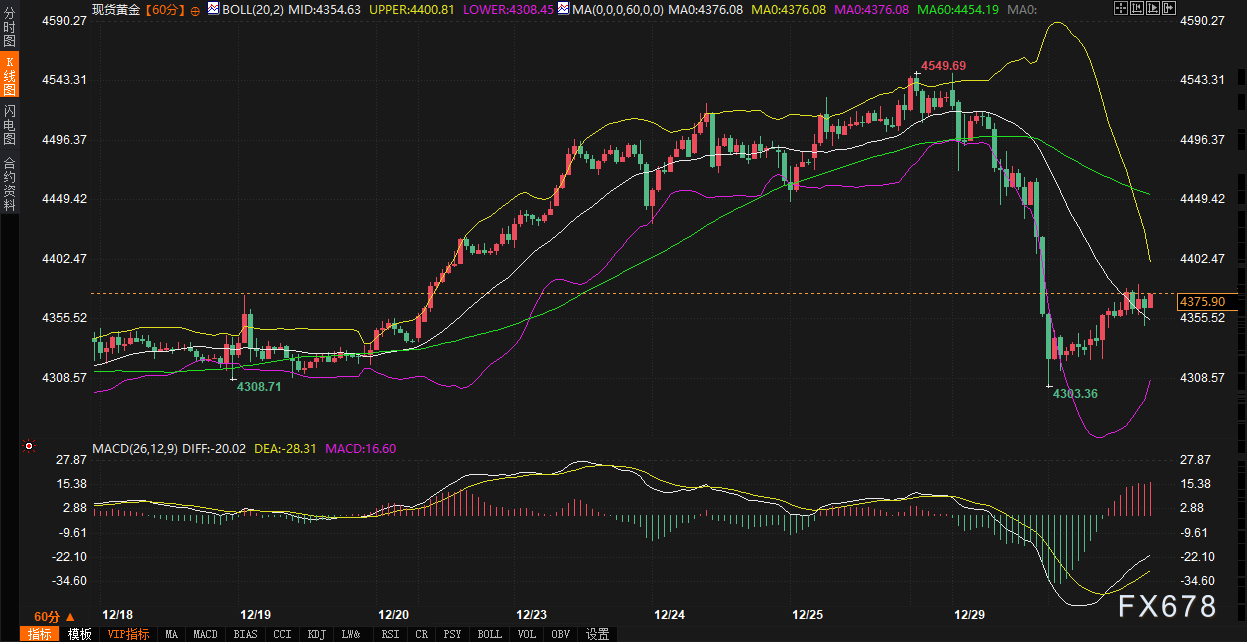
The current quote ($4,375.10) is at a delicate technical position. After Monday’s sharp drop, the price has temporarily moved off the intraday lows but remains well below the green 60-period Simple Moving Average ($4,454.19). The middle band of the Bollinger Bands (parameter 20,2) is at $4,354.61, and gold prices have barely reclaimed this level, indicating bulls are trying to regain short-term control. However, the MACD indicator’s fast and slow lines (DIFF: -20.04, DEA: -28.32) are still below the zero axis and are in bearish alignment, showing that while downward momentum has weakened, the overall trend has not reversed.
From a broader chart structure perspective, Monday's plunge saw gold prices quickly fall from above the Bollinger upper band to near the middle band. This area ($4,300–$4,350) happens to aggregate multiple important technical supports: including the highs of the oscillating platform in mid-to-late December, a key psychological round-number level, and Fibonacci retracement levels from the previous uptrend. Thus, this area serves as the watershed for judging the short-term strength of bulls and bears.
Outlook: From Frenzy to Rationality, the Foundation of a Structural Bull Market Remains
Looking ahead, the gold market is expected to transition from the explosive unilateral rally at the end of 2025 to a more structural, volatile, and mature phase in 2026.
Short term (next few days to weeks): The market will mainly digest Monday's sharp volatility and reassess the balance of bullish and bearish forces. Thin year-end trading may continue to exacerbate price swings. The upcoming release of the Federal Reserve's December meeting minutes will be in the spotlight, as there were reportedly significant internal disagreements at that meeting; the wording on economic assessment and the path of rate cuts in the minutes may provide new short-term trading logic for the market. Gold prices are highly likely to oscillate widely within the core range of $4,300–$4,450, using time to offset the extremes in technical indicators and awaiting new fundamental catalysts.
Medium to long term (2026): The core logic supporting the gold bull market has not collapsed, but the form of its manifestation will change. Central bank gold buying, de-dollarization of reserve allocation, and increased allocation of hard assets by institutional portfolios—these structural demands will continue to provide “ballast” support for gold prices, limiting the scope for deep declines. However, investors should not expect a repeat of the stunning gains seen in 2025. The market will focus more on oscillating upward based on real interest rate expectations, geopolitical risk events, and the trend of the US dollar. Volatility will become the new normal; sharp technical corrections may occur from time to time, but this is more a part of healthy market turnover and trend continuation, rather than a signal of the end of the bull market.
Renowned analyst Kyle Rodda pointed out that the liquidity conditions of the year-end off-season have exacerbated market volatility. Senior market analyst Kelvin Wong maintains a long-term bullish view on gold, seeing a price target of $5,010 within the next six months. Another seasoned industry expert, Robert Gottlieb, offers a representative perspective, believing the current market is transitioning from speculation-driven to a new era supported by structural demand, making the foundation for further gains more solid.
In summary, the sharp correction after spot gold hit a record high is a concentrated release of the severely overbought technical state and short-term liquidity risks. Although the process is intense, it does not overturn the long-term bullish foundation. For market participants, it is crucial to understand and adapt to this mode shift from “frenzied sprint” to “steady trek.” In the future, gold’s performance will be more closely linked to its core attributes as a strategic asset, safe-haven tool, and hedge against currency credit, ushering in a new stage of volatility and opportunity at higher price levels.
Disclaimer: The content of this article solely reflects the author's opinion and does not represent the platform in any capacity. This article is not intended to serve as a reference for making investment decisions.
You may also like
Lummis Says Crypto Bill Will Split Securities and Commodities
Bitmine adds 44K ETH – Can it hold 5% Ethereum stake by 2026?
VOOI Goes Cross-Chain via Chainlink CCIP, Unlocking Native Transfers Across 3 Major Blockchains

Crazy Gold and Silver: How They Affect the Forex Market

Trending news
MoreCrypto prices
More





