
Sonic Price Drops 6% As Wintermute Offloads Token Holdings

Sonic officially parted ways with Wintermute after the market maker dumped $857,000 in tokens, causing a price dip. Sonic implied that no foul play was involved, citing the return of loaned funds.
Sonic publicly revealed that it ended its five-year partnership with Wintermute. A few hours prior, the market maker dumped over $850,000 in S tokens, causing a 6% price drop.
Wintermute was involved in a controversial token dump last month, but today’s events may be part of a normal business interaction. Sonic claimed no foul play, stating that the market maker sold token holdings to return loaned money.
Wintermute and Sonic Part Ways
Sonic (formerly Fantom) has been on an impressive run since launching its native token in January. It hit $1 billion in TVL in only 66 days, and continued its forward momentum with a Binance airdrop.
However, Sonic’s price fell dramatically over the last few hours, as the market maker Wintermute began offloading around $857,000 in S tokens.
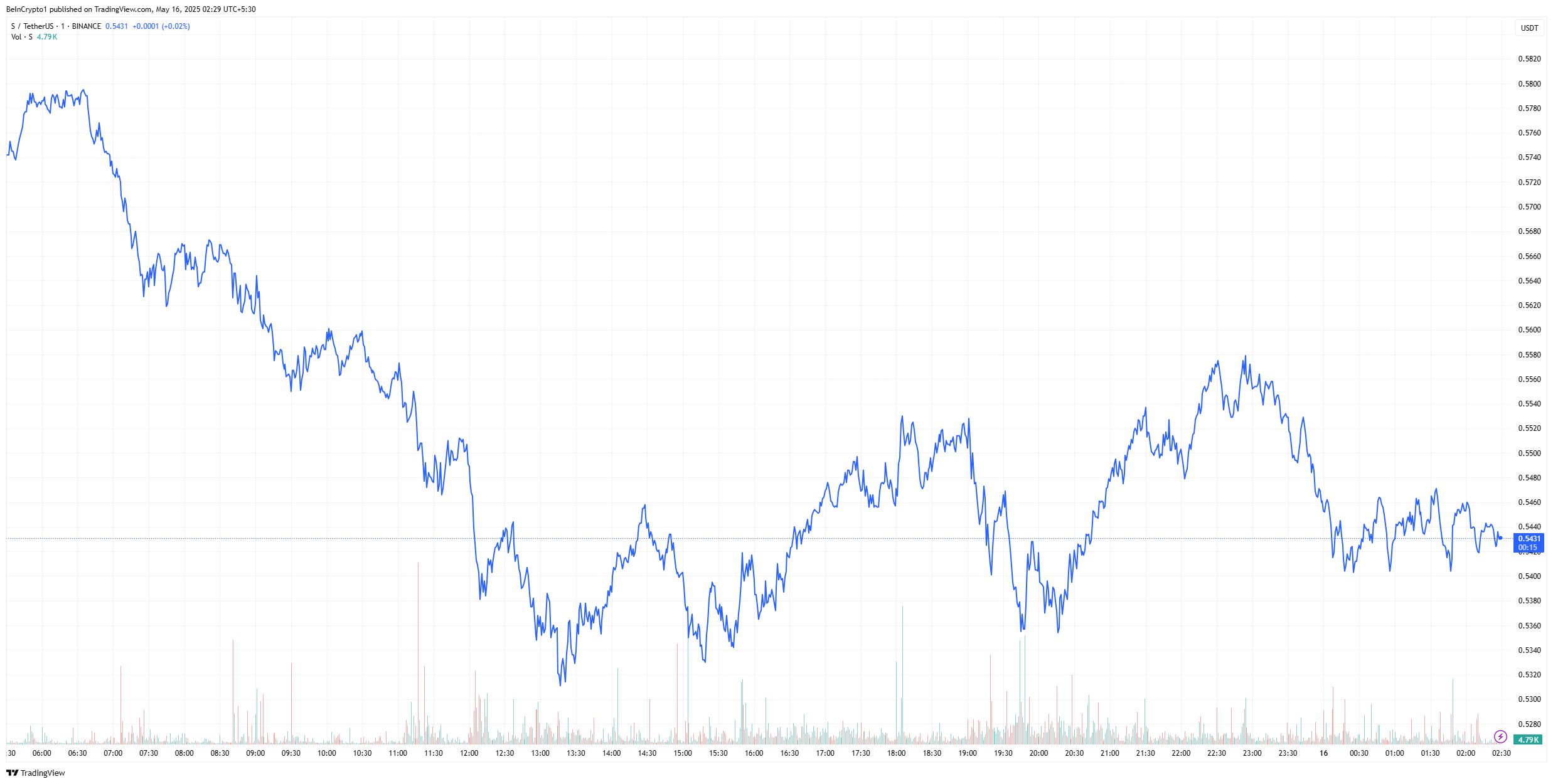 Sonice (S) Price Chart. Source:
TradingView
Sonice (S) Price Chart. Source:
TradingView
Intel Scout, a Sonic ecosystem decoder, was the first to connect S’s price action with Wintermute’s token dumping. He claimed that the market maker sold around 3 million S tokens in 24 hours, and several other whales disposed of even more.
Sonic’s anonymous Head of Strategy responded to these claims, revealing that the companies had split ways:
24 hours ago, we informed @wintermute_t that we will not be renewing our MM contract. We have been using WM exclusively for 5 years of service.We have engaged with other MM firms who are willing to provide MM++, they get involved in our DeFi ecosystem, engage with applications…
— assistant.sonic (@SonicAssistant) May 15, 2025
Sonic’s Head of Strategy went on to state that the company was in talks with several market makers to replace Wintermute.
Specifically, they claimed that CEX only support is “simply no longer enough,” and that this successor needs to proactively engage with Sonic’s DeFi ecosystem, community, apps, and developer team.
Even if Sonic and Wintermute had an amicable breakup, this is not the market maker’s first controversy. In January, the firm faced accusations of market manipulation after $20 million in transactions with Binance.
Last month, Wintermute’s token dump tanked ACT by 50%, only a few months after it partnered with the project. This also led to community outrage.
Nonetheless, today’s actions have not caused a similar scandal yet. If Sonic was dissatisfied with Wintermute’s actions, the company could’ve addressed this, but it didn’t.
It even gave a sympathetic reason for the token sales, explaining that Wintermute needed to return loaned funds. Wintermute, for its part, hasn’t said anything about the episode.
Disclaimer: The content of this article solely reflects the author's opinion and does not represent the platform in any capacity. This article is not intended to serve as a reference for making investment decisions.
You may also like
Over $10 billion in market value evaporated in four trading days as CoreWeave (CRWV.US) debt risks trigger sell-off, but Deutsche Bank sees it as a buying opportunity
Deutsche Bank believes that the recent sell-off of CoreWeave lacks sufficient company fundamentals to justify it, and the sharp price correction has instead created a buying opportunity for investors.

Overnight US Stock Market | Inflation Pressure Continues to Rise, All Three Major Indexes Up, Dell (DELL.US) Down 6.8%
At the close of trading, the Dow Jones Industrial Average rose 557.51 points, or 1.08%, to 52,178.99 points; the S&P 500 Index gained 25.18 points, or 0.33%, to 7,744.12 points; and the Nasdaq Composite Index increased by 20.16 points, or 0.08%, to 26,713.03 points.
Interactive Brokers (IBKR.US) Q3 revenue increased by 16% year-on-year, announces over 70% increase in quarterly dividend
Driven by growth in net interest income and commission income, Interactive Brokers' Q3 net revenue increased by 16% year-on-year, with adjusted earnings per share rising by approximately 18% year-on-year.
CoreWeave default probability exceeds 60%! Jensen Huang "puts out the fire": Financing costs are declining, no need for NVIDIA to backstop
After Jensen Huang's speech, CoreWeave's stock price, which had fallen by as much as 9.5% in early trading, turned positive. The company's five-year CDS rose above 1,190 basis points during Thursday’s session, a historical high reflecting the cost of debt default protection, while yields on some of its corporate bonds have climbed above 15% to 16%. The five-year CDS spreads for Oracle, Amazon, Google’s parent company, and Meta are all at historically high levels. Deutsche Bank analysts believe that as the AI capital expenditure cycle is increasingly supported by debt rather than free cash flow, investors must place greater emphasis on signals from the credit market. Overall, while AI-related financing costs are not yet excessively high, worrying signs have begun to emerge.

Crypto prices
More


