It seems that the final trading days of 2025 have delivered a definitive answer to the question of who is driving the crypto market. After a week of holiday-driven caution and seasonal de-risking, US spot Bitcoin ETFs staged a massive comeback on December 30, recording $355 million in net inflows.
This reversal ended a seven-day slump, signaling that institutional appetites are once again the primary catalyst for price action heading into 2026.
The return of positive ETF flows suggests that industry experts and observers view the $85,000 – $90,000 range as a value zone.
According to data from Coinglass, the rebound was spearheaded by the usual main players. BlackRock’s iShares Bitcoin Trust (IBIT) led the charge with $144 million, followed by Ark 21Shares (ARKB) at $110 million.
What makes this data particularly important is the timing. As retail traders stepped away for the holidays, institutions used the thin liquidity to reestablish control, absorbing nearly $1.1 billion in sell-side pressure over the final 48 hours of the year.
For starters, more than 90% of the recent $355 million Bitcoin ETF inflow was concentrated in the top three funds (IBIT, ARKB, FBTC). Such concentration shows that capital is not just returning but also centralizing in the most liquid, institutional-grade vehicles.
Related: XRP ETFs Defy Market Gloom With $64 Million Weekly Inflow
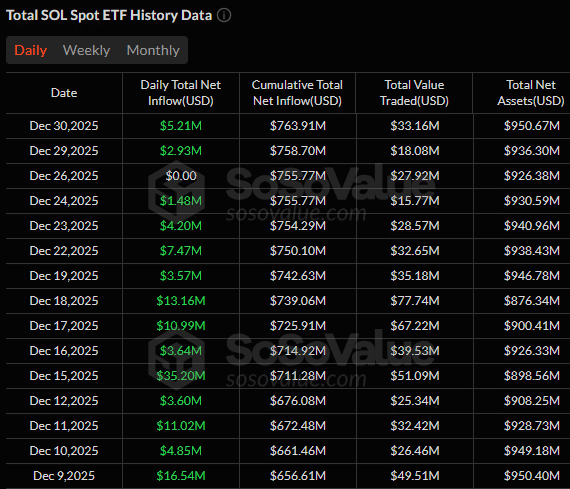
Furthermore, the recovery was not tied solely to Bitcoin. Spot Ethereum ETFs ended a four-day losing streak as well with $67.8 million in inflows, while XRP and Solana funds recorded consistent gains. This suggests a coordinated institutional rotation into the broader crypto asset class.
Then, there is what many perceive as a new market floor. Thanks to considerable accumulation taking place between $75,000 and $95,000 throughout 2025, these funds now act as a defensive barrier, preventing the 70-80% drawdowns seen in previous retail-led cycles.
Heading into 2026, the crypto market has matured beyond the often frantic era of retail-driven volatility. The December 30 reversal proves that when price dips, the ETF engines turn on, providing the liquidity necessary to sustain an upward trajectory.
(adsbygoogle = window.adsbygoogle || []).push({});When it comes to Q1 2026, the ETF inflow will likely be the signal that matters. With institutional giants now firmly in the driver’s seat, the path toward a $150,000 Bitcoin (that many anticipate in 2026) looks less like a gamble and more like a calculated certainty powered by liquidity.
Related: Bitcoin Whales Hit Yearly Highs Amid Holiday Outflows