
These Three Metrics Show Bitcoin Found Strong Support Near $80,000

Bitcoin BTC$90,174.13 has so far bounced above $90,000, 15% higher from its Nov. 21 low of around $80,000, with price finding confluence support across three important cost basis metrics: the 2024 yearly volume weighted cost basis, the True Market Mean, and the average U.S. spot exchange-traded fund (ETF) cost basis.
These metrics help to identify where investors are most likely to defend positions during drawdowns. The area of support proved vital, as it aligned closely with the average acquisition prices of multiple investor cohorts.
First, the True Market Mean, represents the average onchain purchase price of bitcoin held by active market participants. It focuses on coins that have moved recently, filtering out long dormant supply, and therefore reflects the cost basis of investors who are most likely to trade.
During this pullback, the True Market Mean sat near $81,000 and acted as clear support. Notably, bitcoin first moved above this level in October 2023 and had not traded below it since, reinforcing its importance as a structural bull market threshold.
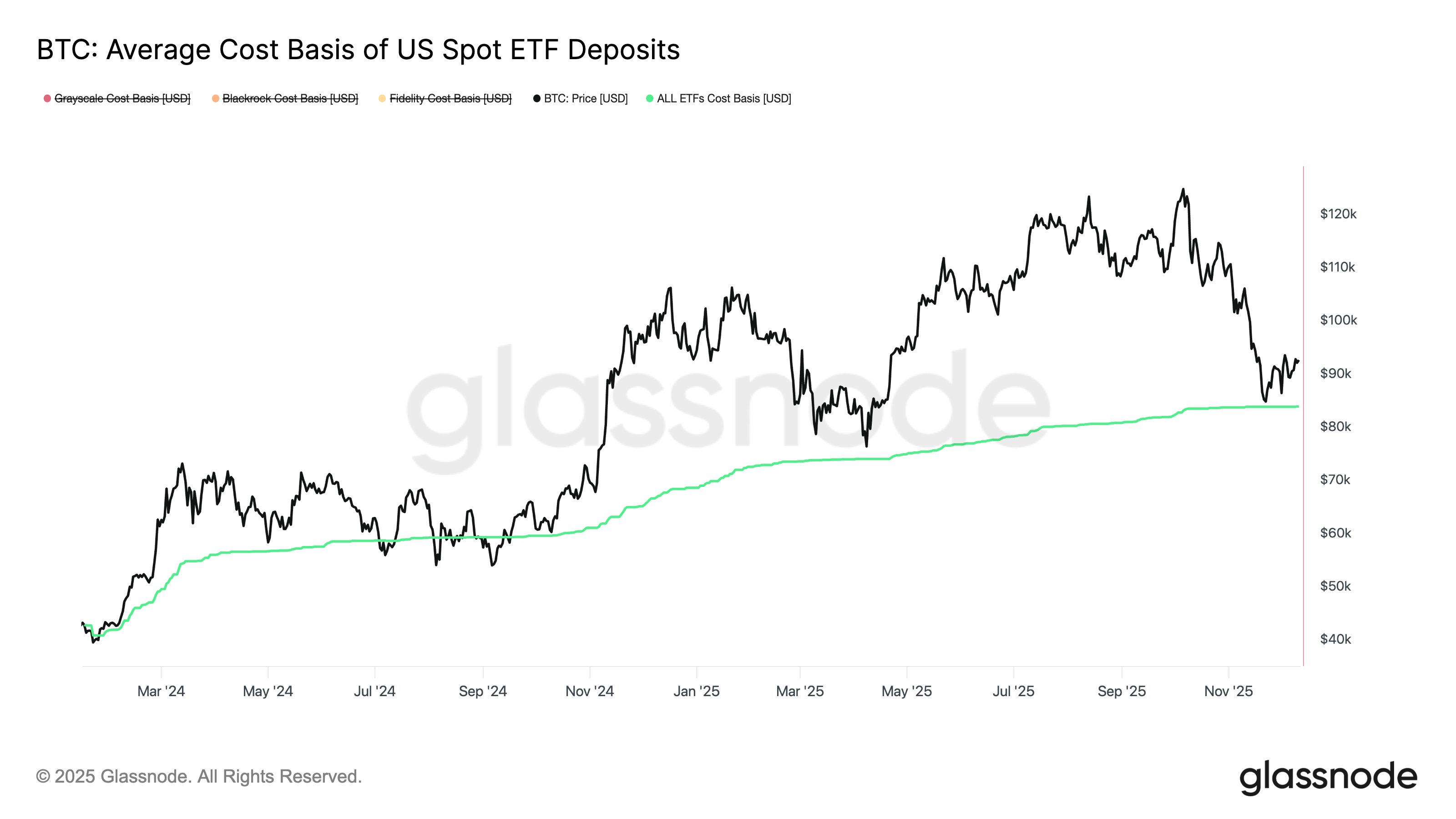
Second, the U.S. spot ETF cost basis reflects the weighted average price at which bitcoin has flowed into U.S. listed spot ETFs. This is calculated by Glassnode using the combined daily ETF inflows with the market price.
The average cost basis currently sits around $83,844, according to Glassnode, and bitcoin once again bounced off this level, which it similarly did during the April tariff-driven selloff.
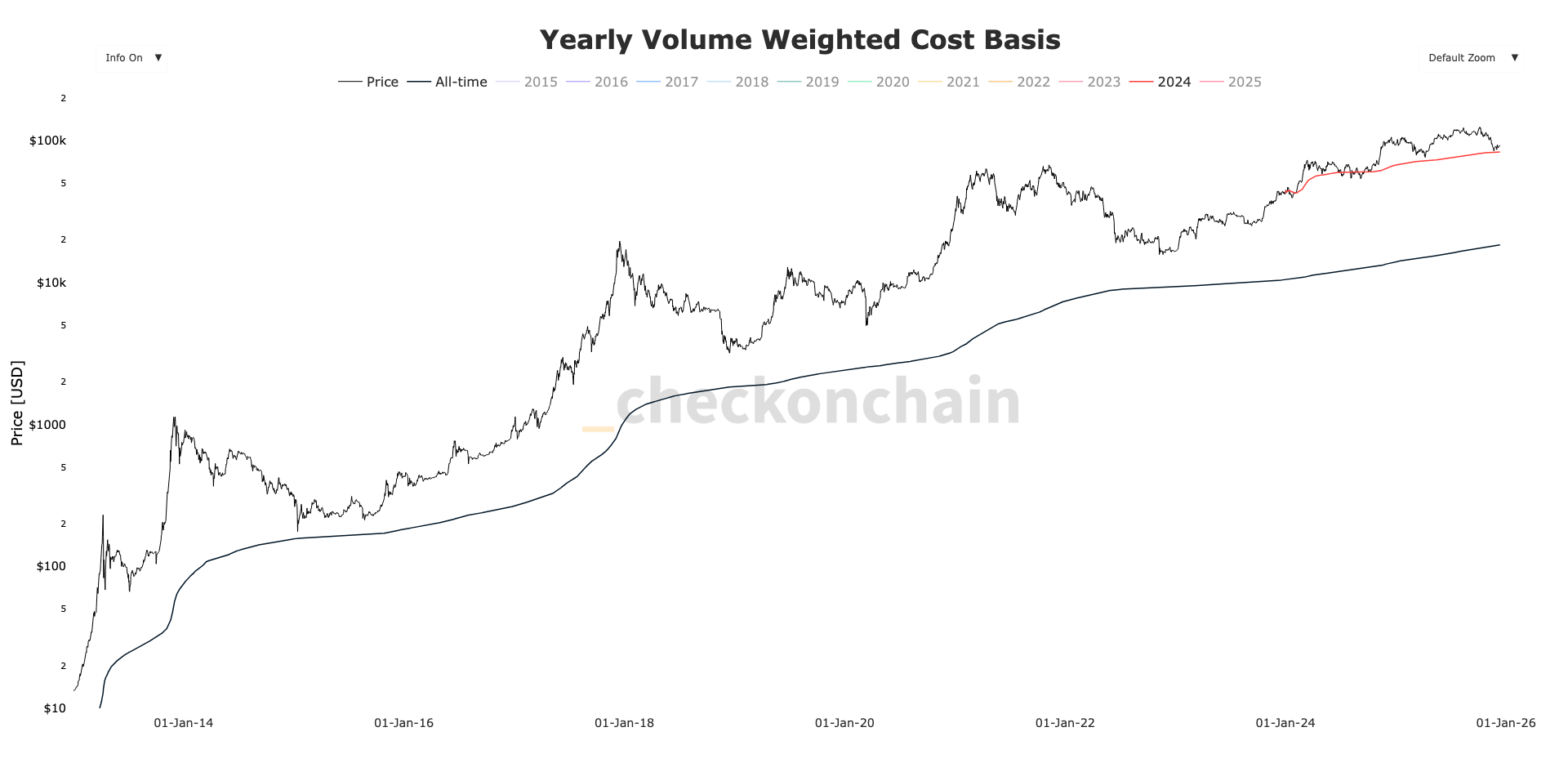
The third metric, the 2024 yearly cost basis, tracks the average price at which coins acquired in 2024 were withdrawn from exchanges. CoinDesk Research has shown a pattern that yearly cohort cost bases tend to act support during bull markets.
In this case, the 2024 cost basis near $83,000, according to checkonchain, provided additional confirmation of demand, again was also seen as support during the April correction.
These metrics highlight the depth of demand of support in the $80,000 region.
Disclaimer: The content of this article solely reflects the author's opinion and does not represent the platform in any capacity. This article is not intended to serve as a reference for making investment decisions.
You may also like
The ICP Surge: Unpacking a 30% Jump and Its Driving Factors
- ICP surged 30% in late October 2025 amid speculation and institutional adoption, driven by Microsoft/Azure partnerships and AI upgrades like Caffeine. - On-chain data shows 35% growth in active addresses but 91% fewer token transfers during downturns, highlighting fragile retail-driven momentum. - TVL hit $237B via asset tokenization, yet dApp engagement dropped 22.4%, signaling volatility despite 40+ tech upgrades including Chain Fusion. - Analysts project $11.15–$88.88 price ranges by 2030, contingent

The Rise of a Structured Market for Clean Energy Derivatives and Its Influence on Institutional Investors
- CFTC's 2025 approval of CleanTrade and other platforms as SEFs transformed the opaque clean energy derivatives market into a transparent, institutional-grade ecosystem. - CleanTrade's $16B notional trading volume in two months highlights surging demand for standardized instruments, attracting BlackRock and Goldman Sachs to hedge decarbonization risks. - ESG-driven institutional investment in renewables reached $75B in Q3 2025, with global clean energy derivatives projected to grow from $39T to $125T by 2

The Rise of a Fluid Clean Energy Marketplace: How CleanTrade is Transforming Institutional Investment in Renewable Resources
- CleanTrade's CFTC-approved SEF platform transforms VPPAs, PPAs, and RECs into institutional-grade renewable energy commodities. - The platform addresses historic market issues like illiquidity and opacity, enabling $16B in notional trading volume within two months. - Industry giants Cargill and Mercuria validate clean energy as a serious asset class through strategic participation in the regulated market. - By aligning financial and ESG goals, CleanTrade creates scalable alpha opportunities as global cle

Clean Energy Market Dynamics and Investment Prospects: The Role of CFTC-Approved Platforms in Facilitating Institutional Participation
- CFTC-approved platforms like CleanTrade are transforming clean energy markets by standardizing derivatives and centralizing trading infrastructure, boosting institutional liquidity and transparency. - CleanTrade’s SEF designation in September 2025 enabled $16B in notional trades within two months, converting illiquid assets like RECs into tradable commodities with ESG-aligned risk management tools. - Institutional demand surged as 70% of large asset owners integrated climate goals, with IRA-driven clean

Trending news
MoreCrypto prices
More





