
PENGU's Notable 7-Day Price Decline: Analyzing Market Reactions and Key Drivers of Crypto Fluctuations
- Pudgy Penguins (PENGU) fell 4.32% in 7 days and 52.55% in 30 days as of Nov 26, 2025, reflecting crypto market fragility. - A $19B October 2025 liquidity crisis triggered cascading liquidations, amplifying PENGU's 30%+ declines amid memecoin sector weakness. - Fear & Greed Index at 27 (extreme fear) and $50M+ long liquidations highlight panic-driven selling and algorithmic trading dynamics. - Technical indicators show conflicting signals: bearish RSI vs. bullish MACD/OBV, with $0.0235 resistance critical
PENGU Faces Steep Decline Amid Crypto Market Turbulence
Over the past week, Pudgy Penguins (PENGU) has experienced a significant price drop, reigniting concerns about the vulnerability of smaller cryptocurrencies in today’s unpredictable market. As of November 26, 2025, PENGU is valued at $0.014523, marking a 4.32% decrease in seven days and a dramatic 52.55% fall over the past month, based on data from CoinCodex. This sharp downturn is part of a larger trend, reflecting both systemic risks and the psychological forces at play within the crypto sector.
Main Drivers: Market Instability and Liquidity Shortages
The primary factor behind PENGU’s recent slide was the liquidity crisis in October 2025, during which $19 billion in leveraged crypto positions were wiped out—a record event that shook even major coins like Bitcoin and Ethereum, according to Bitget. Smaller tokens such as PENGU, which are more sensitive to liquidity disruptions, faced intensified selling. Between November 13 and 18, PENGU’s price tumbled by 30%, followed by another 12% drop on December 2. This was fueled by negative sentiment in the memecoin sector and weakening technical indicators, including the Money Flow Index (MFI) and Parabolic SAR, as reported by CoinMarketCap.
Another key moment occurred when PENGU failed to surpass its crucial resistance level at $0.0235. This triggered a rapid 12% decline within a single day as traders exited long positions. In October alone, over $50 million in long positions were liquidated, according to MEXC, illustrating how breaches of technical levels can accelerate downward momentum in markets dominated by algorithms and herd behavior.
Investor Sentiment: Fear, Herd Mentality, and Blockchain Data
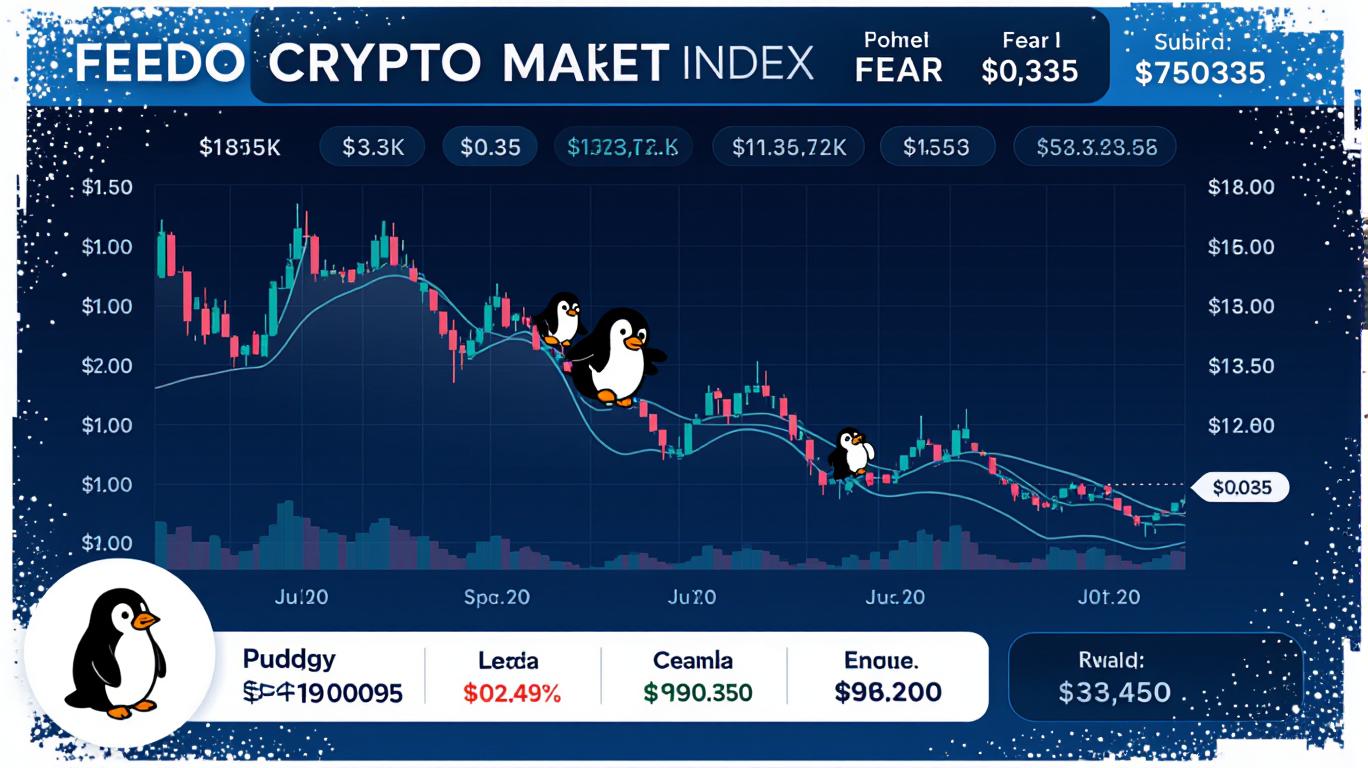
As of November 2025, the Fear & Greed Index stands at 27, signaling widespread fear among investors, according to CoinCodex. On-chain analytics reveal a rise in short positions and increased activity from large holders, both of which often precede sharp corrections. Retail traders, influenced by panic and social media trends, contributed to heightened volatility, pushing PENGU down by 69% from its peak, as noted by Bitget.
Technical analysis paints a mixed picture: while the Relative Strength Index (RSI) points to continued bearishness, indicators like the Moving Average Convergence Divergence (MACD) and On-Balance Volume (OBV) suggest some lingering bullish sentiment, as reported by Bitget. The market appears to be at a turning point—a decisive move above $0.0235 could trigger a 60% rally toward $0.0188, but institutional accumulation patterns hint at the possibility of a short-term reversal, according to BraveNewCoin.
What This Means for Crypto Investors
PENGU’s recent volatility highlights the risks associated with investing in small-cap cryptocurrencies, which often lack the liquidity and institutional support of larger assets. This episode serves as a reminder for investors to be cautious when dealing with high-beta tokens that have weak fundamentals. The October liquidation event also demonstrates how interconnected the crypto ecosystem is—disturbances in one area can quickly impact the entire market.
To navigate these challenges, investors should implement robust risk management strategies that account for liquidity issues and sentiment-driven swings. Tactics such as using options for hedging, diversifying portfolios, and monitoring on-chain metrics like short positions and whale activity can help reduce potential losses. For those watching PENGU, keeping an eye on the $0.0235 resistance level and the Fear & Greed Index may offer early clues to possible trend reversals.
Final Thoughts
The recent decline in PENGU’s price serves as a snapshot of the broader crypto market’s susceptibility to liquidity shortages, shifting sentiment, and technical triggers. While the short-term outlook remains cautious, the mix of conflicting technical signals and ongoing institutional interest suggests that the story is far from over. Investors who approach this volatility with discipline and a deep understanding of market psychology may uncover opportunities once the dust settles.
Disclaimer: The content of this article solely reflects the author's opinion and does not represent the platform in any capacity. This article is not intended to serve as a reference for making investment decisions.
You may also like
ICP Network Expansion: The Adoption of Blockchain Infrastructure and Its Impact on DeFi Investment Approaches
- ICP's 2025 upgrades (Fission, Stellarator) boosted throughput to 11,500 TPS but face decentralization concerns due to 80% node centralization. - Chain Fusion cross-chain protocol enabled Bitcoin/Ethereum interoperability, driving $1.14B TVL growth and attracting institutional partnerships with Microsoft/Google. - Institutions adopt ICP for hybrid cloud/Web3 solutions, prioritizing tokenized RWAs over speculative dApps amid 22.4% Q3 engagement decline. - Analysts project $11.15–$88.88 ICP price range by 2
Zcash Halving and Its Effects on Crypto Markets: Deflationary Dynamics and Investor Perspectives
- Zcash (ZEC) will undergo its next halving in late 2028, reducing block rewards by 50% and aligning with Bitcoin's deflationary model. - The 2024 halving triggered a 1,172% price surge followed by a 96% crash, highlighting volatility from scarcity-driven speculation and macroeconomic factors. - Regulatory challenges like EU MiCA framework scrutiny and reliance on transaction fees raise sustainability concerns as block rewards shrink. - Future success depends on balancing deflationary scarcity with regulat
Assessing How Federal Reserve Policies Influence Emerging Blockchain Assets Such as Solana
- Fed's 2025 rate cuts and liquidity injections initially boosted Solana prices by 3.01% but triggered 6.1% drops during October 2025 liquidations. - Regulatory frameworks like EU MiCA and U.S. GENIUS Act drove 8% institutional ownership of Solana, attracting $101.7M in November 2025 inflows. - 35% of crypto volatility stems from Fed policy shifts, with high-rate environments eroding Solana's appeal as investors favor cash equivalents. - Solana's SIMD-0411 proposal aims to reduce token issuance by $2.9B by

Sustainable Transportation in Cities and the Adoption of Renewable Energy in Developing Economies
- South Africa and India are leading solar-powered transit growth, driven by decarbonization goals and energy security needs in emerging markets. - Solar bus markets project $17.79B value by 2033 (21.6% CAGR), supported by falling solar costs, EV affordability, and policy frameworks in Africa/Asia. - Behavioral economics shapes e-mobility adoption, with South Africa targeting 18,000 tonnes CO₂ reduction via 120 electric buses and India using social nudges to boost EV uptake. - Cross-regional collaboration

Trending news
MoreCrypto prices
More





