
Cardano price forms risky patterns despite Pyth oracle integration

Cardano’s price remained in a bear market after plunging by nearly 60% from its highest point in September, despite several announcements.
- Cardano price has slumped by nearly 60% from its August highs.
- It recently announced a partnership with Pyth Network, a top oracle platform.
- The token has formed bearish patterns, indicating further downside.
Cardano integrates with Pyth Network after Midnight launch
Cardano (ADA) token dropped to $0.4255 today, Dec. 12, even after the network received its first major oracle partnership. In a statement, Cardano said that it had integrated with Pyth Network, one of the biggest oracles in the crypto industry.
Pyth Network (PYTH) secures nearly 300 protocols and has a total value secured or TVS of $4.62 billion. Some of the top protocols it secures are Jupiter, Kamino, Drift, NAVI Lending, and Avantis.
This integration is important for Cardano, a layer-1 network that has struggled to attract developers over the years. One reason for this is that it has had no mainstream oracle provider.
Oracles are essential in the crypto industry as they help to bring off-chain data like price feeds on-chain. With Pyth Network, Cardano developers will now be able to access price feeds of key assets like stocks, cryptocurrencies, commodities, forex, and ETFs.
Therefore, Cardano may begin to gain market share in sectors such as decentralized finance and real-world asset tokenization.
The Pyth integration is also important, as partnerships with blue-chip oracle providers is one of the main objectives of the recent withdrawal of 70 million ADA tokens from the treasury. The other four pillars are stablecoin integrations, cross-chain bridges, institutional custody, and analytics and pricing tools.
The first priority for Cardano's newly formed Critical Integrations workstream?
— Pyth Network 🔮 (@PythNetwork) December 11, 2025
Pyth Pro.
Better data, better price, better experience. https://t.co/1puGXdlcut
The Pyth integration came in the same week that Cardano launched the Midnight mainnet and the NIGHT token, which has gained a market capitalization of over $823 million. Many Cardano holders who participated in the Glacier airdrop and the scavenger mine have already started claiming their NIGHT tokens.
Cardano price technical analysis
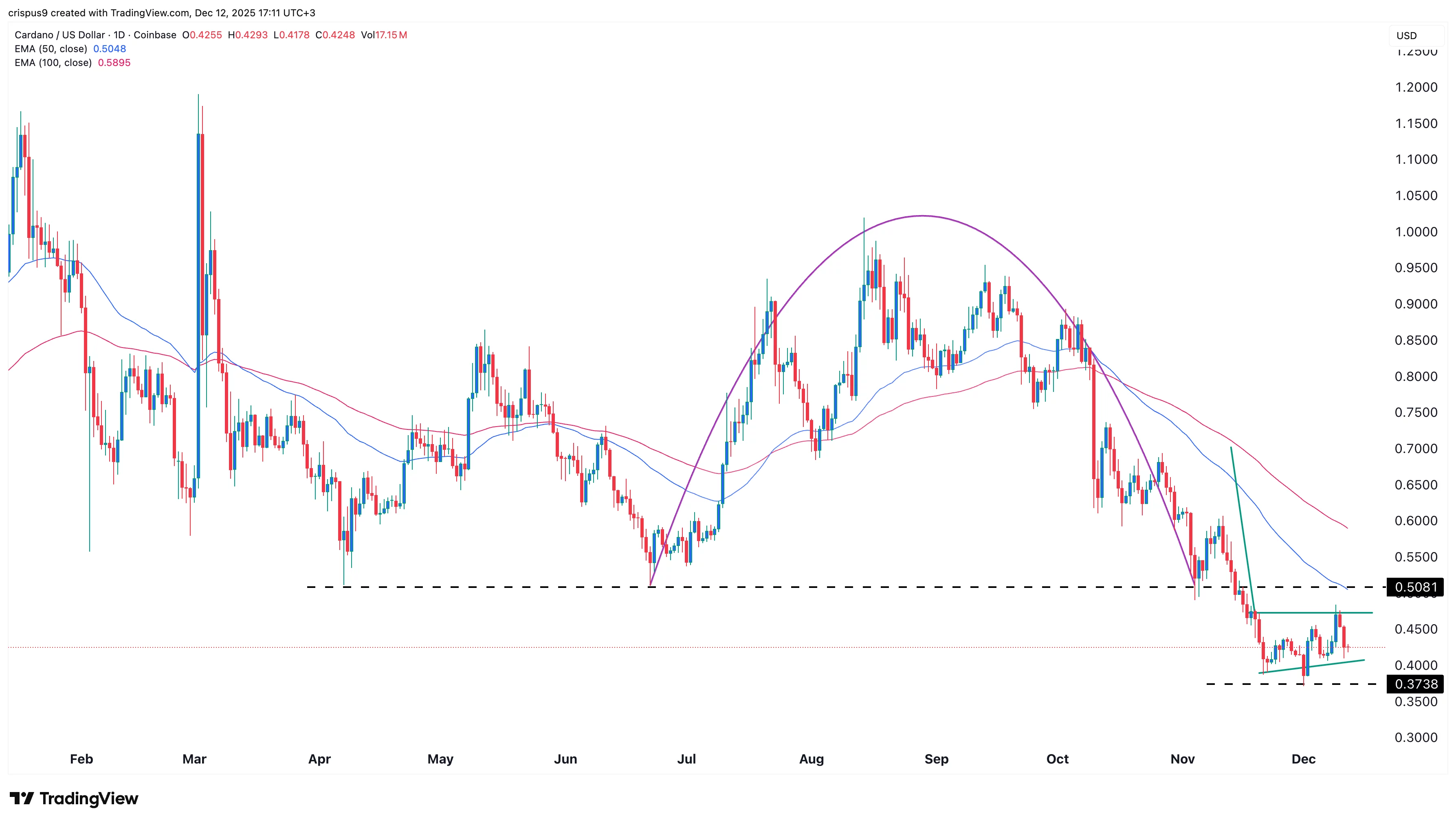
The daily chart shows that ADA price has been in a steep downtrend in the past few months. It recently dropped below the support level at $0.5080, the lower side of the inverted cup-and-handle pattern.
The token has also formed a bearish flag pattern, consisting of a vertical line and a horizontal channel. It remains below the 50-day and 100-day Exponential Moving Averages.
Therefore, the most likely Cardano price forecast is bearish, with the next key target being at $0.30. This view will be confirmed when it drops below this month’s low of $0.3738.
Disclaimer: The content of this article solely reflects the author's opinion and does not represent the platform in any capacity. This article is not intended to serve as a reference for making investment decisions.
You may also like
Zcash (ZEC) Price Rally and Contributing Factors in Late 2025: Privacy-Focused Cryptocurrencies Amid Increasing Regulatory Pressure
- Zcash (ZEC) surged 700% in late 2025, peaking at $728 amid rising demand for privacy-focused crypto amid regulatory scrutiny. - Technological upgrades like Orchard protocol and Zerdinals drove adoption, while institutional investments and endorsements from figures like Winklevoss twins boosted market confidence. - A dynamic fee model stabilized transaction costs, addressing privacy coins' usability challenges during price volatility. - U.S. regulatory engagement with Zcash contrasted with EU plans to ban
ICP Network Expansion: The Adoption of Blockchain Infrastructure and Its Impact on DeFi Investment Approaches
- ICP's 2025 upgrades (Fission, Stellarator) boosted throughput to 11,500 TPS but face decentralization concerns due to 80% node centralization. - Chain Fusion cross-chain protocol enabled Bitcoin/Ethereum interoperability, driving $1.14B TVL growth and attracting institutional partnerships with Microsoft/Google. - Institutions adopt ICP for hybrid cloud/Web3 solutions, prioritizing tokenized RWAs over speculative dApps amid 22.4% Q3 engagement decline. - Analysts project $11.15–$88.88 ICP price range by 2
Zcash Halving and Its Effects on Crypto Markets: Deflationary Dynamics and Investor Perspectives
- Zcash (ZEC) will undergo its next halving in late 2028, reducing block rewards by 50% and aligning with Bitcoin's deflationary model. - The 2024 halving triggered a 1,172% price surge followed by a 96% crash, highlighting volatility from scarcity-driven speculation and macroeconomic factors. - Regulatory challenges like EU MiCA framework scrutiny and reliance on transaction fees raise sustainability concerns as block rewards shrink. - Future success depends on balancing deflationary scarcity with regulat
Assessing How Federal Reserve Policies Influence Emerging Blockchain Assets Such as Solana
- Fed's 2025 rate cuts and liquidity injections initially boosted Solana prices by 3.01% but triggered 6.1% drops during October 2025 liquidations. - Regulatory frameworks like EU MiCA and U.S. GENIUS Act drove 8% institutional ownership of Solana, attracting $101.7M in November 2025 inflows. - 35% of crypto volatility stems from Fed policy shifts, with high-rate environments eroding Solana's appeal as investors favor cash equivalents. - Solana's SIMD-0411 proposal aims to reduce token issuance by $2.9B by

Trending news
MoreCrypto prices
More





