
New ETF Proposal Targets Bitcoin’s Overnight Returns as Outflows Hit Record Levels

Tidal Trust II has filed with the US Securities and Exchange Commission (SEC) for a Bitcoin exchange-traded fund (ETF) designed to provide exposure when US markets are closed. The filing comes as spot BTC ETFs posted their weakest month on record, marked by heavy outflows and rising concerns about potential price manipulation during the US
Tidal Trust II has filed with the US Securities and Exchange Commission (SEC) for a Bitcoin exchange-traded fund (ETF) designed to provide exposure when US markets are closed.
The filing comes as spot BTC ETFs posted their weakest month on record, marked by heavy outflows and rising concerns about potential price manipulation during the US market open.
SEC Filing Reveals ETF That Seeks to Bet on Bitcoin After Hours
The Form N-1A, submitted on Tuesday, proposes to add two ETFs to the existing fund. These include Nicholas Bitcoin and Treasuries AfterDark ETF and Nicholas Bitcoin Tail ETF.
According to the registration statement, the AfterDark ETF will not hold BTC directly. Instead, it will gain exposure through investments in Bitcoin futures, Bitcoin options, and Bitcoin ETFs or ETPs listed in the US.
It may utilize a Cayman Islands subsidiary to manage its positions. The objective is to pursue long-term capital appreciation through a systematic approach that targets Bitcoin’s overnight return profile. Meanwhile, the fund will hold short-term US Treasuries and cash equivalents during the daytime trading period.
“When utilizing Bitcoin Futures, the Fund trades these instruments during US overnight hours and closes them out shortly after the US market opens each trading day. When utilizing Bitcoin Underlying Funds, the Fund purchases a security at US market close, and then sells the position around US market open….When utilizing Bitcoin Options, the Fund typically enters into options positions that establish a synthetic long bitcoin position near the close of regular US trading hours. These positions are typically closed or unwound near the following market open, however, the Fund may hold these synthetic long positions longer term and offset them during US daytime trading hours by entering into a synthetic short position,,” the document reads.
Bloomberg senior ETF analyst Eric Balchunas discussed the strategy in a recent X (formerly Twitter) post. He noted that internal research conducted last year showed a significant share of Bitcoin’s gains occurring during after-hours trading.
“Doesn’t mean the ETFs aren’t having impact. Some of this is positioning bc of the ETFs etc or derivatives based on flows etc etc. But yeah, bitcoin After Dark ETF could put up better returns, we’ll see tho,” Balchunas wrote.
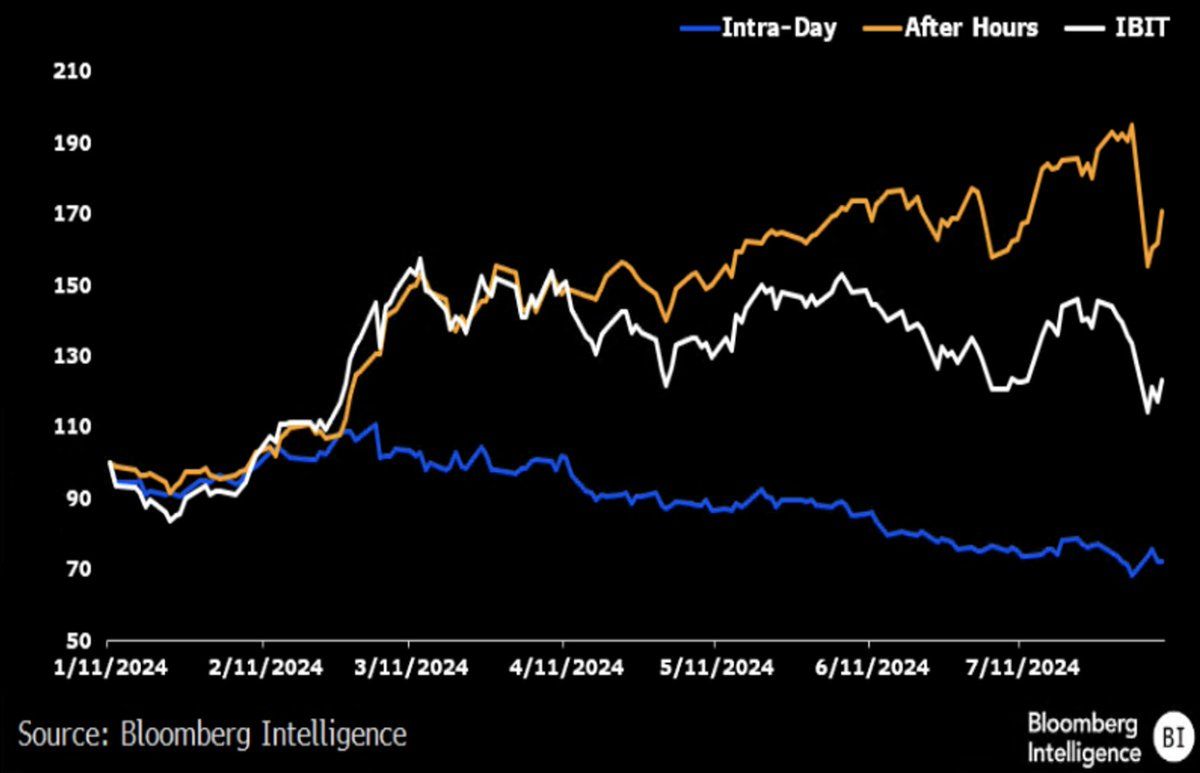 Bitcoin After-Hours Returns. Source:
This filing appears as industry watchers highlight alleged price manipulation during US daytime trading hours. Analysts have identified a recurring pattern of Bitcoin price drops around the market’s opening.
Bitcoin ETF Flows and Investor Sentiment Shift
Meanwhile, spot Bitcoin ETFs have been under significant pressure in the fourth quarter. Data from SoSoValue showed that monthly outflows reached a record $3.48 billion in November. BlackRock’s iShares Bitcoin ETF accounted for the largest share, recording $2.34 billion in outflows.
The heavy withdrawals coincided with a steep decline in Bitcoin’s price, which fell 17.4% in November, its worst monthly performance of the year. This has impacted investor confidence and contributed to renewed caution across digital asset markets.
Outflows extended into December, with another $87.77 million leaving spot Bitcoin ETFs in the first week of the month. Still, the trend showed some signs of stabilizing. On December 9, the funds posted a notable rebound, drawing $151.74 million in inflows.
Disclaimer: The content of this article solely reflects the author's opinion and does not represent the platform in any capacity. This article is not intended to serve as a reference for making investment decisions.
You may also like
The Growing Need for Financial Services Focused on Wellbeing
- Financial services are integrating nine wellness dimensions into financial planning to align well-being with economic outcomes. - Studies show only 38% of individuals achieve ideal financial wellness, linking health and financial resilience. - AI tools and wellness programs boost productivity and retention, with 52% growth in AI coaching since 2020. - Wellness-focused real estate and cultural investments reflect rising demand for holistic prosperity. - The $2 trillion wellness industry drives sustainable

Bitcoin Price Fluctuations: Optimal Entry Strategies Amid Changing Macroeconomic Conditions
- Bitcoin's volatility offers high returns but poses psychological risks, requiring disciplined risk management and emotional resilience. - Social media and behavioral biases like FOMO and loss aversion exacerbate impulsive trading during market swings. - Strategic frameworks (position sizing, DCA) and financial literacy help investors navigate volatility while avoiding overleveraging. - Case studies show predefined plans and diversification reduce panic selling during crashes like the 2024 "Black Friday"

Investing in Sectors Focused on Wellness in 2026: Strategically Aligning with Enduring Human-Centered Trends
- Global wellness market to grow from $6.87T in 2025 to $11T by 2034 at 5.4% CAGR, driven by preventive health, mental wellness, and financial well-being integration. - Wearables (Apple Watch, Oura Ring) and AI platforms (Calm, Headspace) are reshaping physical/emotional wellness, with corporate programs boosting productivity and reducing healthcare costs. - Financial wellness emerges as critical axis, with companies like CHC Wellbeing linking health incentives to economic stability through gamified reward

The Growth and Evaluation of Investments in AI-Powered Educational Technology
- The global AI-driven EdTech market is projected to grow from $7.05B in 2025 to $112.3B by 2034 at 36.02% CAGR, driven by personalized learning and AI-powered tools reducing educator workloads by 25%. - However, 50% of students report reduced teacher connections, 70% of educators fear weakened critical thinking, and 63% of specialists cite AI-related cybersecurity risks, highlighting ethical and systemic challenges. - Anthropology and interdisciplinary approaches address AI biases and cultural gaps, exemp

Trending news
MoreCrypto prices
More





