
“I Wasted 8 Years in Crypto”: A Builder’s Exit Note Goes Viral Across Asia

“I am NOT building a new financial system. I built a casino.”This stark admission from Ken Chan, former co-founder of derivatives protocol Aevo, has been reverberating across Asian crypto communities this week. What began as a post on X has now crossed linguistic borders, been introduced to Chinese communities by local news media, and been
“I am NOT building a new financial system. I built a casino.”This stark admission from Ken Chan, former co-founder of derivatives protocol Aevo, has been reverberating across Asian crypto communities this week.
What began as a post on X has now crossed linguistic borders, been introduced to Chinese communities by local news media, and been widely shared among Korean traders, accumulating millions of views along the way.
From Ayn Rand to Disillusionment: A Libertarian’s Journey Through Crypto
Chan’s confession is not merely a critique—it is the unraveling of a personal ideology. He describes himself as a “starry-eyed libertarian” who donated to Gary Johnson’s 2016 presidential campaign after being radicalized by Ayn Rand’s novels. The cypherpunk ethos of Bitcoin spoke directly to this worldview. “Being able to walk across the border with a billion dollars in your head is and always will be a powerful idea to me,” he writes.
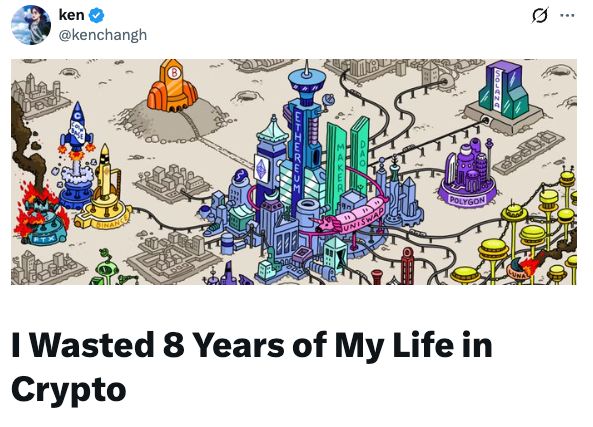
Yet eight years of industry experience eroded that idealism. Chan recounts how the Layer 1 wars—the flood of capital into Aptos, Sui, Sei, ICP, and countless others—produced no meaningful progress toward a new financial system. Instead, it “literally torched everyone’s money” in pursuit of becoming the next Solana. His verdict is unsparing: “We do not need to build the Casino on Mars.”
According to his LinkedIn profile, Chan departed Aevo in May this year. His personal website indicates he is now working on KENSAT, a personal satellite project. It is scheduled to launch aboard a Falcon 9 in June 2026. His confession arrives six months after his departure. It comes as AEVO token trades at roughly $45 million in fully diluted market cap—down approximately 99% from its peak.
The “Casino” Metaphor Lands Amid Market Exhaustion
Chan’s central metaphor—that crypto has become “the biggest, online, multi-player 24/7 casino our generation has ever concocted”—cuts through technical complexity with visceral clarity.
The timing amplifies the message. Following October’s market turbulence and persistent volatility, participants across the region have been grappling with fatigue. The Chinese media framed the viral spread as reflecting “collective anxiety amid liquidity drought and narrative vacuum.”
Chinese-language responses have been divided. Some pushed back sharply: “Same eight years—some reach the summit, others exit the stage. Wasting time is your own problem.” Others went further than Chan himself, with one commenter writing: “The entire crypto circle is foolish, no exceptions. After more than a decade, what blockchain product has the average person actually used?”
Korean responses echoed similar exhaustion. “Besides stablecoins, there’s no real use case,” noted one trader. Another was more blunt: “At the bottom of crypto, there’s no one creating new value for society—just scammers swarming to suck money from retail investors.”
Generational Anxiety Finds a Voice Across Borders
Perhaps most striking is Chan’s warning that the industry’s “toxic mentality will lead to the long-term collapse of social mobility for the younger generation.” This concern resonates deeply in East Asian societies. Traditional paths to wealth—real estate, stable employment—have grown increasingly inaccessible. Crypto promised an alternative; Chan suggests it may be accelerating the problem.
Korean analyst KKD Whale offered a parallel reflection without directly addressing Chan’s post. “The era of standing alone with just one core skill is passing,” he wrote, recalling a talented colleague who could compress eight hours of work into one but never bothered to deepen his expertise. The skill became obsolete; the person moved on.
While Chan questions what the industry has built, KKD Whale questions what individuals have accumulated within it. Both arrive at the same unsettling destination.
Chan closes with a quote from CMS Holdings: “Do you want to make money, or do you want to be right?” His answer: “I choose to be right this time.”
Six months after leaving the project he built, and with AEVO trading at a fraction of its former value, the question lingers: Is this the clarity of hindsight, or the convenience of exit? The viral journey of his confession suggests many others are asking themselves the same question.
Disclaimer: The content of this article solely reflects the author's opinion and does not represent the platform in any capacity. This article is not intended to serve as a reference for making investment decisions.
You may also like
Assessing How Federal Reserve Policies Influence Emerging Blockchain Assets Such as Solana
- Fed's 2025 rate cuts and liquidity injections initially boosted Solana prices by 3.01% but triggered 6.1% drops during October 2025 liquidations. - Regulatory frameworks like EU MiCA and U.S. GENIUS Act drove 8% institutional ownership of Solana, attracting $101.7M in November 2025 inflows. - 35% of crypto volatility stems from Fed policy shifts, with high-rate environments eroding Solana's appeal as investors favor cash equivalents. - Solana's SIMD-0411 proposal aims to reduce token issuance by $2.9B by

Sustainable Transportation in Cities and the Adoption of Renewable Energy in Developing Economies
- South Africa and India are leading solar-powered transit growth, driven by decarbonization goals and energy security needs in emerging markets. - Solar bus markets project $17.79B value by 2033 (21.6% CAGR), supported by falling solar costs, EV affordability, and policy frameworks in Africa/Asia. - Behavioral economics shapes e-mobility adoption, with South Africa targeting 18,000 tonnes CO₂ reduction via 120 electric buses and India using social nudges to boost EV uptake. - Cross-regional collaboration

A detailed overview of technology layoffs in 2025
PENGU Price Forecast for 2025: Steering Through Regulatory Challenges and Growing Institutional Confidence
- Pudgy Penguins (PENGU) faces regulatory uncertainty from SEC delays and EU MiCA, causing 30% price drops due to compliance risks. - Institutional interest grows with $273K whale accumulation and rising OBV, contrasting retail fear (Fear & Greed Index at 28). - Ecosystem expansion via Pudgy World and penguSOL, plus Bitso partnership, aims to boost utility but depends on user adoption and regulation. - Expert forecasts diverge: $0.02782 (CoinCodex) vs. $0.068 (CoinDCX), with technical analysis highlighting
Trending news
MoreCrypto prices
More





