
JPMorgan Denies Political Motive Behind Crypto Account Closure Tied to Trump

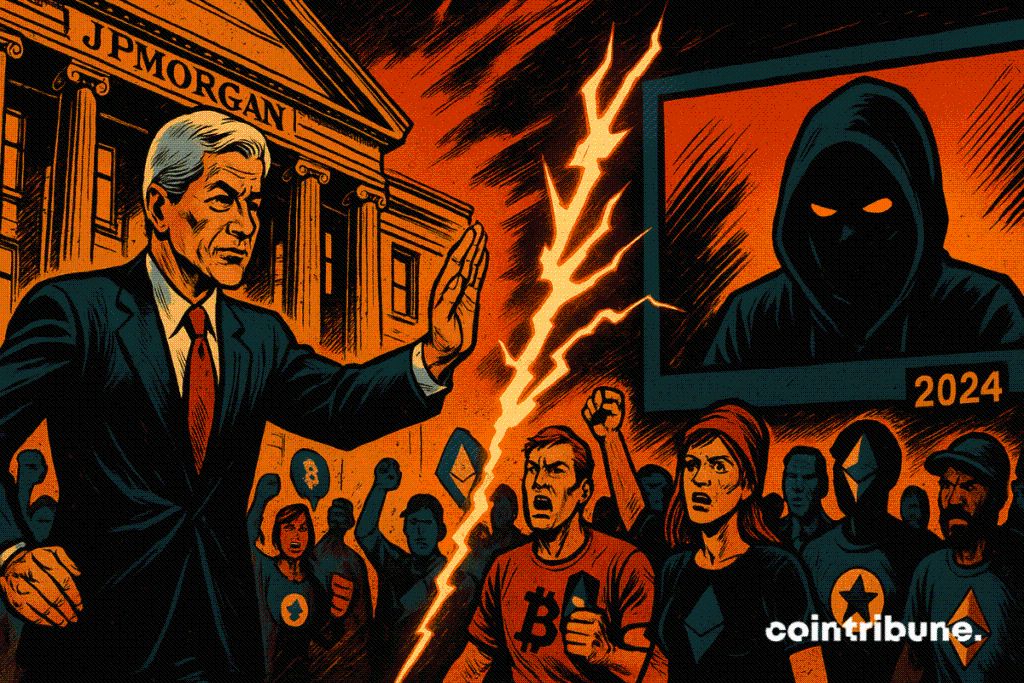
Crypto account closures reignite controversy between financial institutions and conservative figures. JPMorgan is indeed accused of targeting pro-Trump users. Its CEO, Jamie Dimon, firmly rejects this version.
In brief
- JPMorgan denies targeting crypto actors for political or ideological reasons.
- Jamie Dimon calls for reform of debanking rules deemed unclear and unfair.
Crypto and account closure: accusations rain down on JPMorgan
Several personalities in the crypto sector denounce the closure of their bank accounts by JPMorgan, without clear justification.
- The CEO of Strike Jack Mallers claims, for example, to have lost access to his personal funds.
- Trump Media, headed by Devin Nunes, mentions a similar blockage.
- The same scenario on the crypto platform ShapeShift.
These incidents revive fears of a new “Operation Chokepoint”. Some administrations use this controversial method to restrict access to crypto banking services.
Jamie Dimon, JPMorgan CEO, categorically rejects these allegations during an interview with Fox News.
The debate actually touches a sensitive point: the neutrality of banks in the face of the rise of digital assets. More precisely referring to the massive debanking that raises the question of possible financial censorship hidden behind vague compliance rules.
Crypto, Trump and regulation: Jamie Dimon’s strong defense
Jamie Dimon affirms he has been advocating for 15 years to reform the rules that push banks to close accounts on mere suspicion or media reporting. He thus calls for a clarification of the financial regulation standards imposed on banks.
Dimon reminds that JPMorgan never delivers information to authorities without a subpoena. However, he accuses the political climate of turning banks into easy targets. For him, the problem comes from the law (and not the intentions of the institution).
The crypto community therefore fears an abusive use of these procedures, seen as a barrier to decentralized finance. In a context where digital wallets are gaining popularity, each incident fuels distrust toward traditional actors.
In any case, the war between crypto supporters and traditional banks seems far from settled. Regulation will have to decide between control and innovation, before a real gap grows between two visions of finance.
Disclaimer: The content of this article solely reflects the author's opinion and does not represent the platform in any capacity. This article is not intended to serve as a reference for making investment decisions.
You may also like
HYPE Token Experiences Rapid Growth in December 2025: Evaluating Authenticity and Investment Opportunities Amidst an Unstable Post-ETF Cryptocurrency Landscape
- HYPE token surged in Dec 2025 amid post-Bitcoin ETF crypto optimism , raising questions about its investment legitimacy. - Hyperliquid's 72.7% decentralized trading volume share and $106M monthly revenue highlight its DeFi infrastructure strength. - Institutional backing from Paradigm and a $1B DAT fund signals confidence, though major exchange listings remain pending. - Price volatility, token unlocks, and mixed expert opinions underscore risks, with potential $53–$71 targets contingent on market condit
LUNA Falls by 5.77% Over 24 Hours Despite Fluctuating Medium-Term Performance
- LUNA fell 5.77% in 24 hours to $0.1512, but rose 47.52% in 7 days and 105.96% in 30 days. - However, it still faces a 64.14% annual loss, highlighting crypto market volatility and long-term risks for investors. - The price swing reflects sensitivity to macroeconomic shifts and sentiment, with analysts noting ongoing uncertainty in forecasts. - Investors are weighing recent resilience against regulatory challenges and institutional behavior shifts, monitoring if the drop signals a bearish trend or tempora
The Downfall of ChainOpera AI Token: An Alert for AI-Based Cryptocurrency Investments
- ChainOpera AI (COAI) token's 96% collapse in late 2025 highlights systemic risks in AI-driven crypto assets, prompting reevaluation of governance and regulatory frameworks. - Centralized ownership (88% by top 10 holders) and governance flaws at C3.ai exacerbated volatility, undermining decentralization and investor trust. - The crisis triggered sector-wide sell-offs, shifting capital to meme coins, while 2025 regulatory penalties rose 417% to $1.23B, intensifying scrutiny. - Experts warn speculative AI-c

Top 5 Utility-Backed Crypto Projects: Real-World Integrations Surge as Institutional Interest Climbs 48% This Quarter

Trending news
MoreCrypto prices
More





