
LUNA surges by 81.58% over the past week as bankruptcy-driven rally unfolds
- LUNA surged 81.58% in 7 days amid bankruptcy-linked crypto rallies, contrasting a 68.87% annual decline. - Market speculation tied to Sam Bankman-Fried's legal status drove short-term gains, though pardon odds remain at 2%. - The rally reflects thematic trading rather than fundamental recovery, with LUNA's future dependent on ecosystem health.
LUNA Price Movements and Market Trends
As of December 7, 2025, LUNA experienced a 3.44% decrease over the previous 24 hours, settling at $0.1292. Despite this short-term dip, the token surged by 81.58% over the past week and climbed 78.81% in the last month. However, looking at the bigger picture, LUNA has dropped 68.87% over the past year.
Bankruptcy-Related Tokens Spark Market Rally
In late November and early December 2025, LUNA saw a dramatic resurgence, gaining over 81% in just seven days. This rally coincided with a broader uptick in digital assets associated with bankruptcy proceedings. Several tokens tied to prominent insolvency cases experienced sharp increases—USTC, for example, soared more than 78% in a single day, while LUNC and FTT also posted notable gains.
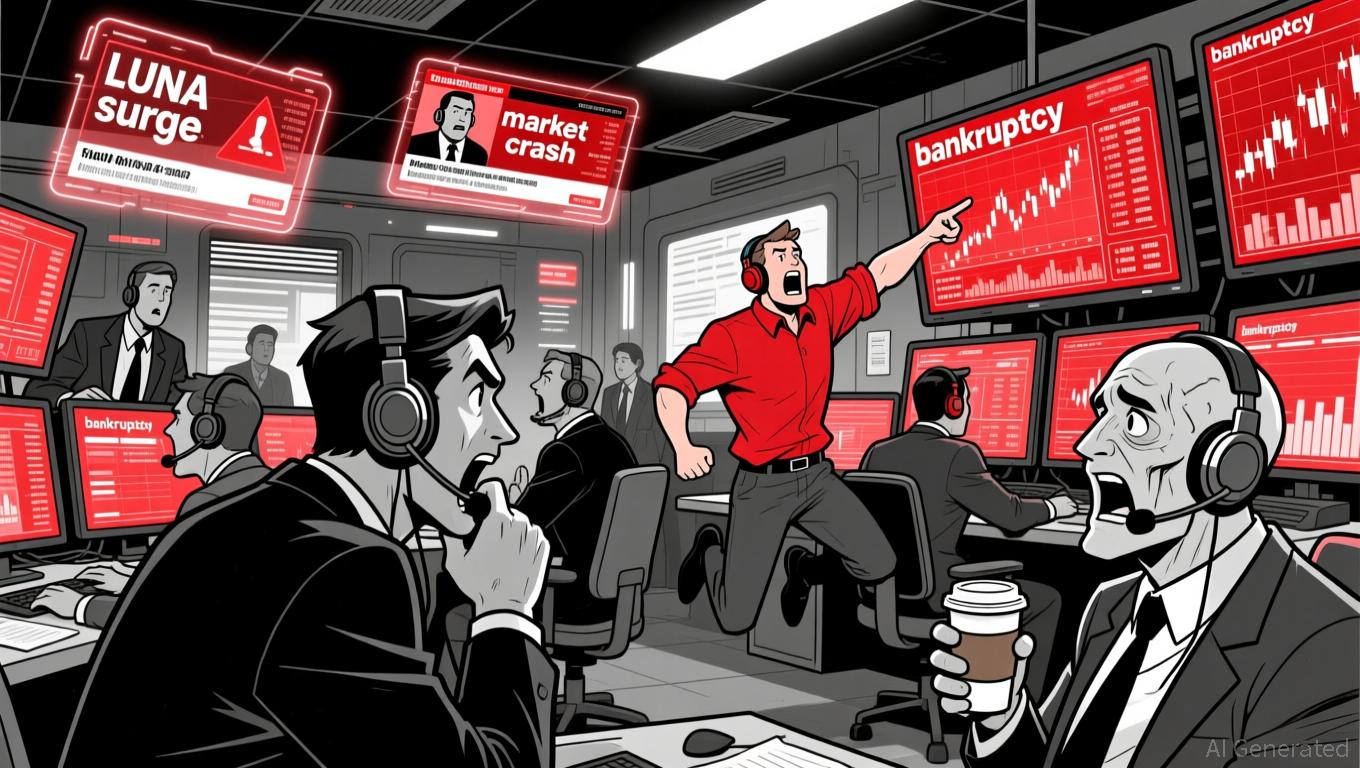
LUNA’s rebound highlights the speculative tendencies of the crypto market, where investor optimism often shifts in response to evolving narratives around influential industry players. Although LUNA’s 24-hour increase was a more modest 39%, it still represented a significant turnaround from its steep annual decline.
Assessing LUNA’s Recent Performance
The recent volatility in LUNA’s price underscores the ongoing uncertainty surrounding the token. While the past week’s surge stands in stark contrast to its 68.87% annual drop, this pattern suggests that, although short-term enthusiasm for bankruptcy-linked assets is strong, lasting confidence in LUNA’s ecosystem has yet to be restored.
Market Sentiment and Investor Reactions
The surge in tokens connected to bankruptcy cases, including LUNA, appears to be fueled by shifting market sentiment and speculative trading. Recent comments from former FTX founder Sam Bankman-Fried, made from prison, have reignited speculation about potential pardons or legal relief. Despite this, as of December 7, 2025, the likelihood of a pardon—such as one from Donald Trump—remains low, with prediction markets estimating the chance at just 2%.
Investors have responded quickly to these developments. LUNA’s price movements have mirrored the broader mood toward projects with historical links to similar ecosystems, indicating that the rally is driven more by thematic speculation than by fundamental improvements.
Future Outlook for LUNA
With the current rally largely propelled by market sentiment and speculation, it remains uncertain whether LUNA can maintain its recent gains and establish a more stable upward trajectory. At present, price fluctuations seem to reflect broader trends rather than any significant progress within the project itself.
Market analysts suggest that ongoing attention to bankruptcy-related assets and legal proceedings could continue to influence token prices in the near future. However, LUNA’s long-term prospects will ultimately depend on the strength of its underlying technology, practical applications, and governance structure.
Summary
LUNA’s sharp rebound over the past week, driven by renewed interest in bankruptcy-linked cryptocurrencies, marks a notable shift in momentum. Nevertheless, the token still faces significant challenges, having lost nearly 69% of its value over the past year. The market remains highly speculative, and LUNA’s future performance will hinge on both investor sentiment and the project’s fundamental development.
Disclaimer: The content of this article solely reflects the author's opinion and does not represent the platform in any capacity. This article is not intended to serve as a reference for making investment decisions.
You may also like
The Growing Influence of Artificial Intelligence on Universities and Preparing Tomorrow’s Workforce
- AI integration in higher education drives academic program expansion, with 2.5% undergraduate and 3% graduate enrollment growth in 2024. - Universities invest $33.9B in generative AI to modernize curricula and partner with industries , addressing 58% workforce readiness gaps. - AI-driven tools boost student retention (52% adoption) and project 1.5% U.S. GDP growth by 2035 through automation in key sectors. - Challenges persist: 71% academic integrity concerns and 52% training gaps highlight risks in AI a

The CFTC-Sanctioned Transformation in Clean Energy Trading
- CFTC's 2025 withdrawal of carbon credit derivatives guidance creates regulatory uncertainty but sparks innovation in blockchain/AI solutions. - OBBBA's 2026 construction deadline accelerates solar/wind project cancellations while preserving tax credit transferability mechanisms. - Battery storage, geothermal, and hydrogen emerge as resilient sectors amid market shifts, supported by IRA tax credits and OZ modernization. - Investors prioritizing domestic supply chains and third-party certified projects gai
Aligning university programs with new technology sectors to pinpoint areas with strong investment potential
- Higher education is redefining curricula to align with AI, quantum computing, green energy, and biotech sectors, addressing urgent talent gaps. - Green energy apprenticeships (e.g., ACE Network) and biotech-AI hybrid training programs are scaling rapidly to meet workforce demands. - Quantum computing initiatives like Connecticut's $1B QuantumCT plan highlight trillion-dollar investment potential in talent development and infrastructure. - AI ethics integration and edtech platforms for real-time labor mar

Tight Range Emerges: PEPE Trades at $0.054368 With 4.1% Weekly Decline and Key Levels in Focus

Trending news
MoreCrypto prices
More





