
MicroStrategy Builds $1.44B Cash Wall as Bitcoin Signals Turn Bearish

MicroStrategy strengthened its balance sheet by establishing a $1.44 billion USD reserve, a move CryptoQuant interprets as preparation for a potential Bitcoin downturn. The firm created this reserve through recent equity sales, and the action marks a noticeable shift from its relentless Bitcoin acquisition strategy that pushed its holdings above 252,000 BTC, valued at roughly $16 billion.
Company Secures Cash Without Selling Bitcoin
MicroStrategy actively maintained its reputation as Bitcoin’s largest corporate holder by protecting its BTC stack while securing liquidity. The company allocated the reserve to cover preferred stock dividends and ongoing debt obligations, ensuring financial stability without liquidating Bitcoin. This approach reflects a strategic effort to weather volatility while keeping long-term BTC exposure intact.
Market Pressures Intensify Strategy Adjustments
MicroStrategy responded to market stress as its stock price dropped nearly 60% from its highs, falling toward the $177 range. The downturn coincided with a month-long Bitcoin selloff that elevated uncertainty across institutional markets. By building this substantial reserve, the company signaled its awareness of macroeconomic risks and prepared proactively rather than reactively.
On-Chain Signals Mirror Past Caution Zones
CryptoQuant’s analysis noted that Bitcoin’s on-chain indicators now resemble caution zones last seen in late 2022, including weakening demand, slowing whale accumulation, and declining realized profits. MicroStrategy’s shift toward liquidity aligns with these indicators, and analysts interpret the move as a hedge against deepening volatility rather than a reversal of its long-term BTC conviction.
Community Reacts With Mixed Sentiment
Market participants reacted emotionally across social platforms, with some insisting the move strengthens Bitcoin’s resilience and others warning it reflects growing fear across institutional players. The wider community debated whether this liquidity boost could stabilize long-term investor sentiment if a bear trend accelerates. The discussion highlighted how MicroStrategy’s actions continue to influence crypto psychology.
Disclaimer: The content of this article solely reflects the author's opinion and does not represent the platform in any capacity. This article is not intended to serve as a reference for making investment decisions.
You may also like
Investment Prospects in STEM Learning and Workforce-Ready Talent Streams: Linking with Astar 2.0
- Global STEM education demand surges as AI, blockchain, and biotech reshape industries, creating workforce skill gaps. - Astar 2.0's DeFi innovations (ZK Rollups, interoperability) indirectly support STEM through blockchain infrastructure and cross-chain collaboration. - U.S. and Singapore prioritize tech-integrated workforce strategies, aligning with Astar 2.0's potential to bridge DeFi and STEM education via scalable tools. - Investors can leverage Astar 2.0's $1.399B TVL and hybrid AMM-CEX model to fun

The ZK Transformation: Evaluating How Zero-Knowledge Technology Influences the Future Development of Blockchain
- ZK-rollups scale blockchain networks by bundling transactions, achieving 43,000 TPS and 30% lower gas fees, attracting institutions like Goldman Sachs and JPMorgan . - ZK technology resolves privacy-scalability paradox by enabling verifiable transactions without data exposure, adopted by EU regulators and enterprises like Nike and Sony . - Challenges persist: ZK-SNARKs require heavy computation, trusted setup risks exist, and privacy conflicts with AML regulations in some jurisdictions. - $725M+ VC inves

The Influence of Vitalik Buterin's Support for ZKsync on the Advancement of Scalable Blockchain Technologies: Evaluating the Prospects for Long-Term Investment in Pr
- Vitalik Buterin's 2025 endorsement of ZKsync accelerated its rise as a scalable Ethereum Layer-2 solution with 30,000 TPS and $3.3B TVL. - ZKsync's EVM compatibility and institutional partnerships contrast with StarkNet's quantum-resistant STARK proofs and Aztec's privacy-first architecture. - Analysts project ZK token prices at $0.40–$0.60 by 2025, while StarkNet faces adoption barriers and Aztec navigates regulatory challenges in privacy-focused DeFi. - The $7.59B ZKP market (2033 forecast) hinges on b
ZK Atlas Enhancement: Transforming Blockchain Scalability and Paving the Way for Institutional Integration
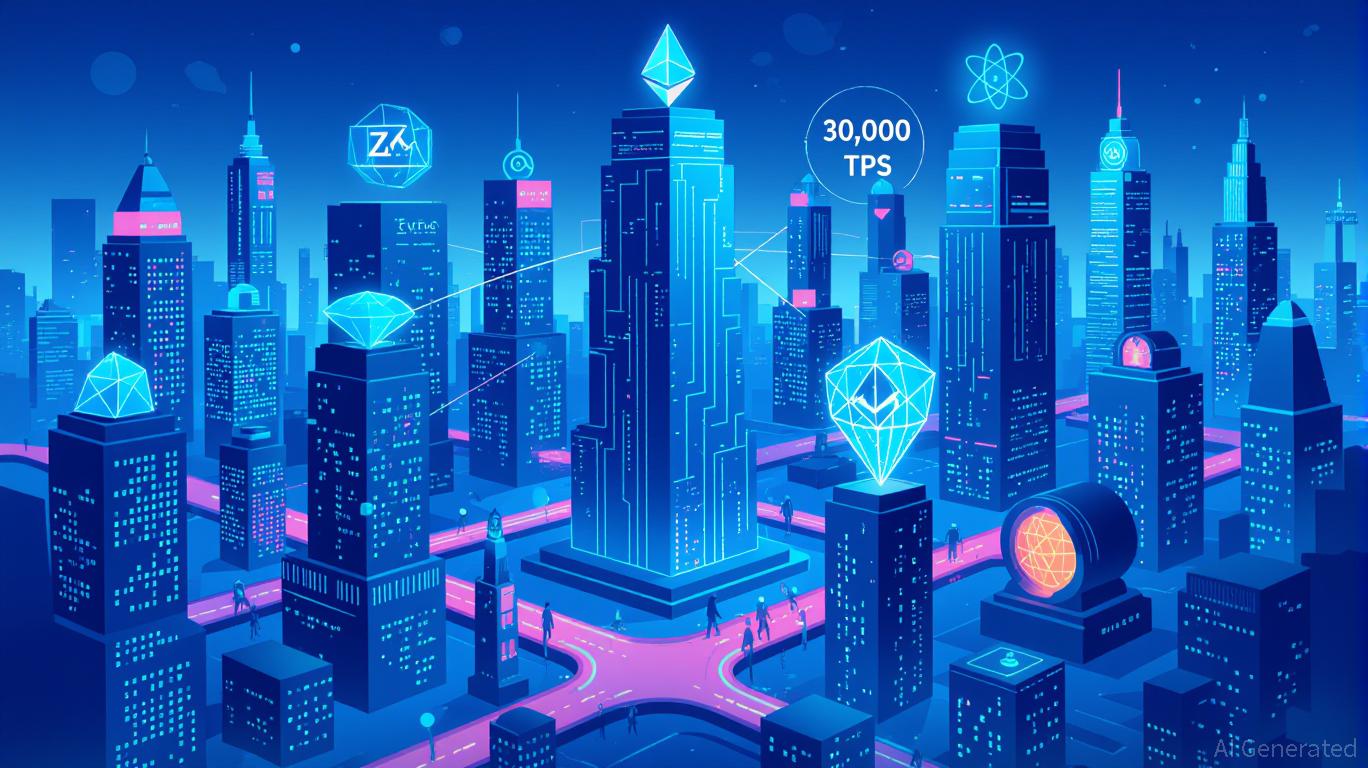
- ZKsync’s 2025 Atlas Upgrade achieves 15,000–43,000 TPS with $0.0001/transaction costs, boosting blockchain scalability for institutions. - Deutsche Bank , Sony , and Citi adopt ZKsync for tokenized assets and privacy-driven transactions, citing compliance and efficiency gains. - Market forecasts predict 60.7% CAGR for ZK Layer-2 solutions through 2031, with Fusaka upgrade targeting 30,000 TPS to solidify ZKsync’s leadership.
Trending news
MoreCrypto prices
More





