
Hyperliquid News Today: Hyperliquid’s Robust Scalability and Performance Foster Stability Amid Market Volatility
- Hyperliquid's HYPE token rebounded to $40 after a 54% drop following a 1.75M token unlock, showing market resilience. - Analysts credit its $330B monthly trading volume and efficient operations for maintaining investor confidence amid volatility. - The recovery aligns with broader crypto trends, including $70M Bitcoin ETF inflows and growing institutional interest in scalable DeFi platforms. - Regulatory developments like Binance's HNWI services and UK stablecoin tests signal maturing market infrastructu
Hyperliquid Demonstrates Strength Amid Token Unlock and Market Turbulence
Despite the release of 1.75 million HYPE tokens on September 19, 2025, Hyperliquid—a leading decentralized exchange—has managed to regain investor trust. The token experienced a sharp 54% decline during the October 10 market downturn, which saw some altcoins lose as much as 95% of their value. Remarkably, HYPE rebounded to the $40 mark within just two days, showcasing the platform’s resilience in the face of significant market instability. Analysts credit this swift recovery to Hyperliquid’s impressive operational performance, including its capacity to process $330 billion in monthly trades with a lean development team.
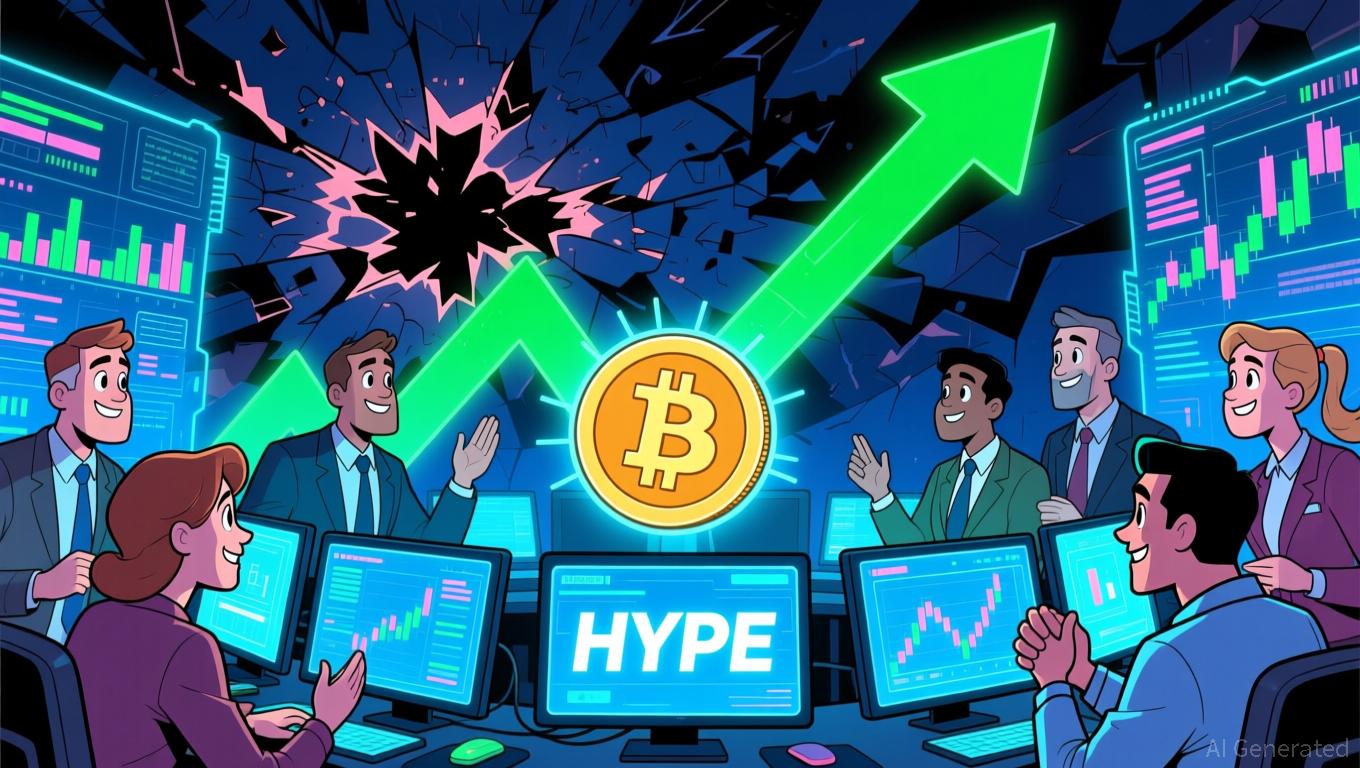
This rapid price recovery highlights a broader pattern in the cryptocurrency sector: even in the presence of widespread fear and uncertainty, buyers remain undeterred. This trend is mirrored by recent developments such as $70 million in net inflows to spot Bitcoin ETFs and a $312.6 million reversal in Ether ETF flows, signaling renewed optimism among investors after a period of sustained outflows. While institutional interest in Bitcoin and Ether ETFs is on the rise, Hyperliquid’s robust performance underscores the increasing popularity of high-volume, cost-efficient trading platforms.
Hyperliquid’s continued growth is further bolstered by its strategic approach. The exchange has earned recognition for its strong revenue streams and operational effectiveness, with experts highlighting its ability to support substantial trading activity without sacrificing user satisfaction. These strengths have established Hyperliquid as a significant force within the decentralized finance (DeFi) landscape, where scalability and affordability are key competitive advantages.
The resilience of the broader crypto market is evident in other areas as well. For example, Binance’s recent launch of a tailored service for ultra-high-net-worth clients and the UK’s stablecoin pilot program reflect a more mature regulatory climate, which may help reinforce investor confidence. Additionally, market observers such as Mister Crypto and André Dragosch of Bitwise Europe suggest that Bitcoin may be nearing a short-term bottom, further contributing to a positive outlook for risk-oriented assets.
Although recent volatility has tested the market, the unlocking of Hyperliquid’s tokens has not significantly weakened its standing. The platform’s emphasis on supporting large trading volumes with minimal infrastructure expenses aligns with the growing demand for scalable and efficient solutions. This focus is especially important as shifting macroeconomic conditions prompt investors to seek projects that offer tangible utility and transparent operations.
As the cryptocurrency market enters a phase of consolidation, Hyperliquid stands out as an example of how strong fundamentals can help platforms navigate periods of uncertainty. The recent token unlock, while initially disruptive, ultimately demonstrated the platform’s capacity for rapid recovery—a quality that may appeal to long-term investors looking for stability in an evolving market.
Disclaimer: The content of this article solely reflects the author's opinion and does not represent the platform in any capacity. This article is not intended to serve as a reference for making investment decisions.
You may also like
Tether (USDT) Price Fluctuations and Market Response to PENGU Sell Indicators: Assessing Potential Risks and Opportunities within a Divided Stablecoin Landscape
- Tether (USDT) faced 2025 depegging to $0.90, exposing reserve management flaws and triggering S&P's "weak" stability rating. - Algorithmic PENGU USDT's 28.5% price drop and $66.6M team outflows highlighted systemic risks in opaque collateral structures. - Regulatory shifts (GENIUS Act, MiCA) accelerated migration to compliant stablecoins like USDC , now dominating 30% of on-chain transaction volume. - Market fragmentation reveals dual dynamics: algorithmic risks vs. institutional adoption opportunities i

DASH Increases by 2.44% as Significant Insider Selling and Purchase Indicators Emerge
- DASH rose 2.44% in 24 hours to $50.1, showing a 31.63% annual gain despite a 11.79% seven-day drop. - High-ranking insiders sold millions via 10b5-1 plans, including $9. 3M by Stanley Tang and $6.19M by Andy Fang. - Alfred Lin’s $100.2M purchase signaled confidence, contrasting with other sales and suggesting undervaluation. - Market reacted positively short-term, but analysts expect macroeconomic and business fundamentals to support DASH ahead.

BCH Rises 36.52% Over the Past Year as Network Enhancements and Improved Mining Efficiency Drive Growth
- Bitcoin Cash (BCH) rose 36.52% in a year due to network upgrades and improved mining efficiency. - Growing merchant adoption boosts real-world use cases, enhancing BCH’s practical appeal. - Analysts predict continued momentum from stable updates and adoption efforts amid crypto volatility. - Recent stability, with no major forks, strengthens investor confidence in BCH’s scalability.

Why is COAI experiencing a downturn towards the end of 2025
- COAI token and index collapsed in late 2025 due to deteriorating market fundamentals, governance failures, and regulatory uncertainty. - C3 AI's Q3 2025 revenue growth (26% YoY) was overshadowed by Q1 2026 revenue decline (20% YoY) and leadership instability, eroding investor trust. - Token centralization (87.9% in ten wallets) and lack of transparent governance exacerbated liquidity crises and manipulation risks. - The CLARITY Act's ambiguity and jurisdictional loopholes deepened uncertainty, deterring

Trending news
MoreCrypto prices
More






