Kaspa (KAS) has entered December with unexpected strength, delivering a sharp rebound at a time when most altcoins are still absorbing the damage from October’s downturn. Over the last seven days, Kaspa has climbed roughly 30–40%, depending on the exchange, extending its recovery from the November low near $0.044.
Meanwhile, a different type of narrative is forming in the background — one centered not on speed or throughput, but on privacy, verifiable compute, and zero-knowledge infrastructure. That’s where Zero Knowledge Proof (ZKP), a fully built, privacy-first AI blockchain, is beginning to attract attention as the next cycle’s potential breakout.
Sponsored
Below is a breakdown of why Kaspa is moving now — and why ZKP is the privacy play analysts are starting to watch.
Kaspa’s Bounce Continues as Investors Reprice PoW BlockDAG Strength
Kaspa’s 7-day climb comes after one of its most difficult periods of 2025. October saw multi-week capitulation, declining liquidity, and one of the steepest drops in sector sentiment. But the past week has brought several short-term tailwinds:
- Price is up ~35–40% over the past week
- 6% daily gain as of Dec 1, 2025
- Recovery from the early-November low at $0.044
The shift has largely been attributed to improving liquidity and stronger flows around high-throughput proof-of-work networks. CoinGlass data and market models indicate a significant return of buyers in the final week of November, likely driven by traders positioning themselves ahead of a potential Binance listing, a rumor circulating in the community.
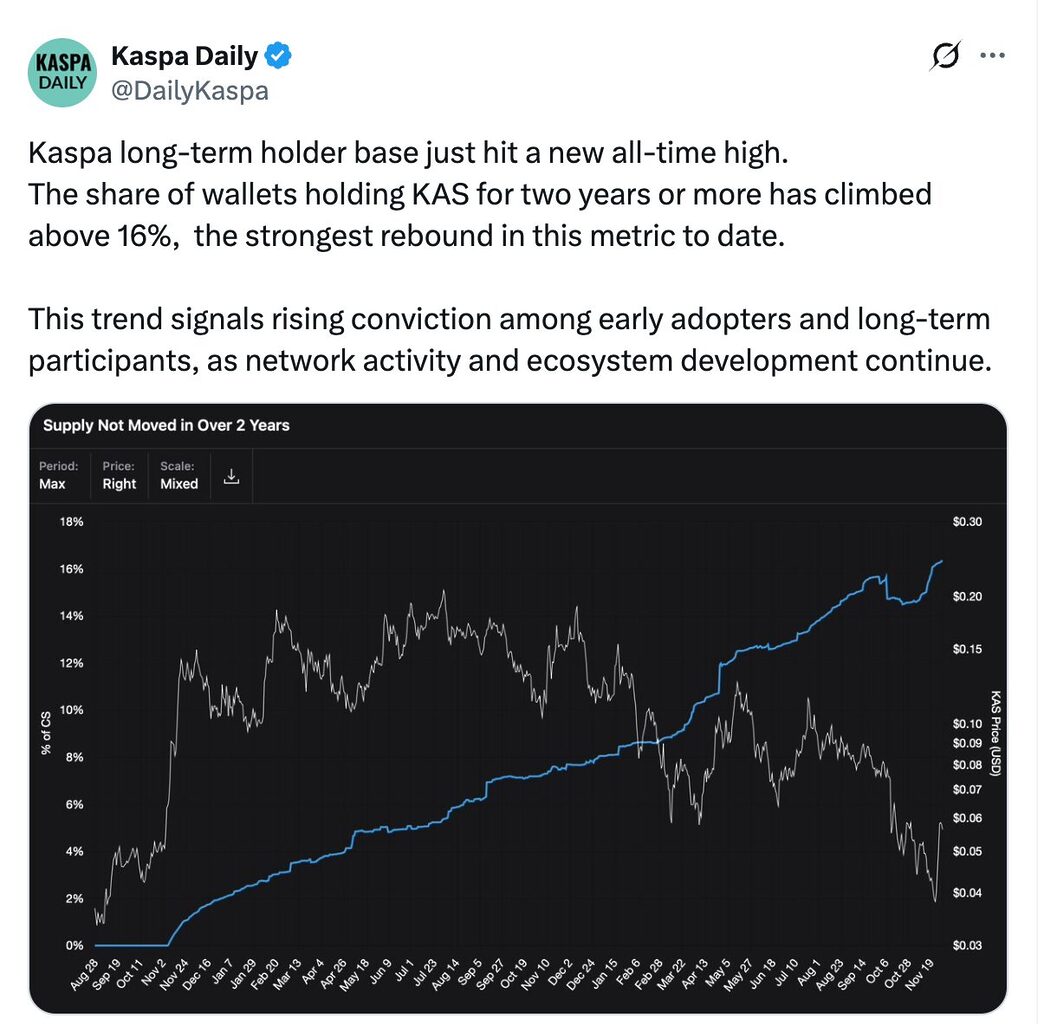
Kaspa’s close correlation with Bitcoin has also helped. With BTC stabilizing around $91,800, volatility has cooled enough to let high-quality altcoins rebuild momentum — a pattern seen repeatedly during consolidation cycles.
Why Kaspa’s Fundamentals Still Matter in a Quiet Market
Beyond price action, analysts continue to return to Kaspa’s structural strengths:
1. BlockDAG PoW at High Throughput
Kaspa utilizes GHOSTDAG, a proof-of-work architecture that enables parallel block production at over 10 blocks per second today, with a long-term roadmap targeting 100 blocks per second.
In recent stress tests:
- 158 million transactions processed in a single day
- 5,700 transactions per second (peak) recorded in a controlled load test
This places Kaspa among the highest-throughput PoW systems ever tested.
2. Smart-Contracts and L2 Expansion
While historically a payments chain, Kaspa’s 2025 roadmap centers on:
- A dedicated smart-contracts L2 (Casplex)
- ZK-friendly extensions for attestation systems
- Tools enabling dApps on top of the blockDAG
- Enterprise-grade high-frequency applications

This positions Kaspa less as a “Bitcoin competitor” and more as a settlement-grade PoW network that may eventually sit alongside Ethereum and Solana once L2 support matures.
But While Kaspa Rebounds, Privacy Takes Center Stage — and ZKP Enters the Picture
Even with Kaspa’s strong recovery, the narrative gaining the most momentum into 2026 isn’t throughput — it’s privacy.
As data becomes the world’s most valuable commodity, blockchains are under pressure to process information without exposing the underlying inputs. This has opened a new category: privacy + AI + verifiable compute, a domain where Zero Knowledge Proof (ZKP) is emerging as a contender.
ZKP is a fully built blockchain network that merges decentralized compute with zero-knowledge proofs. Unlike most early-stage projects, ZKP:
- Self-funded over $100M before selling any token
- Has its testnet live
- Has Proof Pods already deployed globally
The positioning is simple: while Kaspa focuses on high-throughput PoW, ZKP targets the future of private computation, where AI workloads, encrypted data, and verifiable results can all run without exposing sensitive information.
Why Analysts View ZKP as the Next Big Privacy Play
1. Privacy for AI — Not Just Transactions
Monero protects transactions.
ZKP protects AI workloads, data, and computation.
Every task solved on the network generates a mathematical proof confirming correctness without revealing the data inside.
2. Hardware That Works in the Real World
ZKP’s plug-and-play Proof Pods — already live — let users earn by running real computations:
- No mining puzzles
- No GPU farming
- No exposure of user data
This allows the network to scale real AI jobs privately.
Where Kaspa and ZKP Fit in the 2026 Landscape
The two projects sit in different categories — both relevant, but for different reasons:
- Kaspa: high-throughput PoW, commodity-style settlement, L2 smart-contracts coming
- ZKP: privacy-first compute, AI verification, zero-knowledge execution
Kaspa’s recent pump confirms that strong L1 fundamentals still matter.
ZKP’s rise suggests the next major rotation may revolve around privacy and compute, not just throughput.
Both themes are likely to shape 2026 — but ZKP sits at the intersection of where the long-term privacy narrative is headed.