
SOL Price Forecast and Institutional Integration: How Scalability and Business Growth Drive Adoption
- Solana's 2024–2025 upgrades, including Firedancer and Alpenglow, boost scalability to 1M+ TPS, enhancing institutional adoption in Singapore. - Institutional demand grows as enterprises adopt Solana for tokenized assets and DeFi, driven by low fees and high throughput. - 2025–2026 price forecasts range from $150–$420, with long-term targets up to $1,707.55 by 2030, contingent on tech innovation and regulatory clarity.
Solana’s Rapid Evolution: Setting the Stage for the Future
Solana has quickly established itself as a leading force in the quest for scalable, enterprise-ready blockchain infrastructure. Thanks to a series of major technological advancements in 2024 and 2025, and a notable increase in institutional participation, Solana (SOL) is now a central figure in the worlds of decentralized finance (DeFi) and digital asset tokenization. This overview examines how Solana’s innovations in scalability and its growing appeal to institutions are influencing price outlooks for 2025, 2026, and beyond.
Breakthroughs in Scalability: Building a Robust Network
Solana’s transaction processing power has moved from theory to practice, now exceeding 1 million transactions per second (TPS) due to the introduction of the Firedancer validator client. Created by Jump Crypto, this C/C++-based client has achieved testnet speeds above 1 million TPS, while also lowering the hardware requirements for validators. By introducing multiple validator clients, Firedancer reduces the likelihood of network-wide disruptions, thereby boosting both security and reliability.
Another key upgrade, Alpenglow consensus, brings a streamlined voting system that cuts down on latency and eliminates unnecessary communication between validators. Initial testing shows block finality times of less than 150 milliseconds, a crucial improvement for applications requiring real-time transactions. Alongside these upgrades, Solana has doubled its block space and increased compute units per block by 25%, paving the way for large-scale applications such as gaming, asset tokenization, and international payments.
Institutional Momentum: Fueling Network Growth
Interest from major institutions in Solana is on the rise, especially in regions like Singapore where regulatory policies align well with Solana’s design. Businesses are taking advantage of Solana’s low transaction costs and high throughput for tokenization, digital settlements, and DeFi infrastructure, as highlighted in recent industry reports. The ecosystem now features advanced tools, secure custody options, and compliance frameworks, making it easier for enterprises to integrate Solana into their operations.
This wave of institutional adoption is more than just speculation. Leading financial organizations and corporations are actively implementing Solana for tokenized securities and supply chain management, directly increasing demand for SOL. As one market observer puts it, “The synergy between Solana’s technical strengths and its real-world use cases is creating a positive feedback loop, driving both utility and value across the network.”
Forecasting SOL’s Price: Weighing Potential and Caution
Predictions for SOL’s price in 2025 and 2026 reflect a blend of optimism and prudence. Most projections for 2025 place SOL between $150 and $300, with a typical expectation around $230 and a bullish scenario reaching $300. Looking ahead to 2026, estimates range from $180 to $420, propelled by the Firedancer upgrade and increasing activity in decentralized applications. Some analysts foresee SOL climbing to $320 in 2026 if market conditions remain favorable.
Long-term outlooks are even more ambitious. By 2030, certain experts anticipate SOL trading between $450 and $680, with the possibility of hitting $1,000 if regulatory clarity and artificial intelligence integration further drive adoption. Another analysis suggests a 2030 target as high as $1,707.55, citing ongoing network growth and sustained institutional interest. These forecasts depend on continued technological progress, stable macroeconomic conditions, and the ongoing expansion of Solana’s ecosystem.
Final Thoughts: Navigating Opportunity and Risk
Solana’s development path highlights its goal to serve as the backbone for global financial systems. The combination of advanced scalability and increasing institutional use creates a strong case for long-term value. However, investors should remain aware of potential challenges, including regulatory changes, competition from Ethereum’s layer-2 solutions, and broader economic uncertainties. For those prepared to manage these risks, Solana offers a compelling opportunity to be part of the next wave of blockchain innovation.
Disclaimer: The content of this article solely reflects the author's opinion and does not represent the platform in any capacity. This article is not intended to serve as a reference for making investment decisions.
You may also like
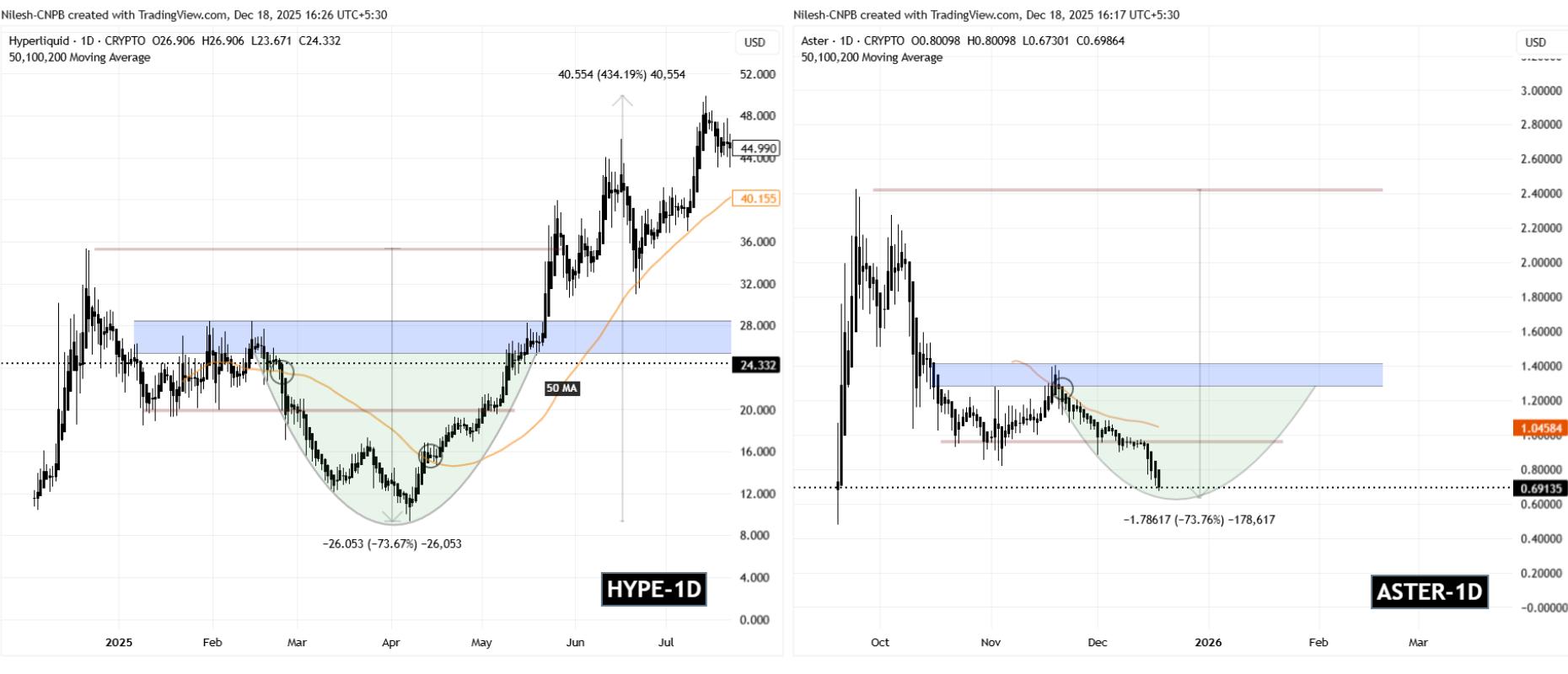
Is Aster ($ASTER) Nearing a Potential Bottom? A Key Emerging Fractal Suggests So!
XRP Algorithmic Trading Hits US Retirement Accounts with Digital Wealth Partners
Indian MP Proposes Bill for Asset Tokenization via Blockchain
Ethereum’s Future Gas Limit Increase: Rumors and Realities
Trending news
MoreCrypto prices
More





