CLO Price Analysis: Yei Finance Rollout SolvBTC Token on Cross-Chain Protocol, Unlocking DeFi BTC Liquidity

SolvBTC, a Bitcoin-backed liquid staking token powered by Solv Protocol, is now available on Yei Finance, a DeFi network focusing on aggregating cross-chain liquidity. Today, December 12, 2025, Yei Finance (also commonly known as Clovis) announced the integration of the SolvBTC token on its DeFi platform.
By launching the SolvBTC token on its decentralized network, Yei Finance provides its users with access to a Bitcoin staking product that allows them to earn yields. The biggest limitation of Bitcoin is its inability to support smart contracts and DeFi natively. Yei Finance understands this gap as an opportunity. By integrating with the Solv Protocol, Yei provides its users with an innovative approach to connect their idle BTC tokens to greater liquidity and put them to work, and as a result, generate yields.
📢 xSolvBTC by @SolvProtocol is now live on Yei Finance's Main Market
— Yei Finance (@YeiFinance) December 12, 2025
xSolvBTC is a liquid, yield-bearing Bitcoin token tied to staked BTC in the @babylonlabs_io ecosystem.
Current xSolvBTC positions on the Solv Market should be migrated to the Main Market for continued… pic.twitter.com/QpgRyvH6N0
SolvBTC in Yei Finance: What This Means
SolvBTC is a Bitcoin-driven liquid staking token (operated by Solv Protocol), designed to enable BTC holders to participate in DeFi ecosystems and earn yields while maintaining BTC exposure. Established in April 2024, SolvBTC has quickly risen to become a key financial product within Solv’s DeFi offerings.
The above integration means that Yei Finance users can now deposit their Bitcoin tokens and mint SolvBTC, which functions as a liquid representation of staked BTC, providing customers with BTC-denominated returns. The integration with Solv also means that Bitcoin holders on the Yei Finance platform can now utilize SolvBTC across various DeFi protocols to earn greater yields in various lending platforms, DEXs, DeFi vaults, and other decentralized platforms. Yield is produced through strategies like automated compounding and liquidity provision in Solv’s DeFi vaults.
Yei Finance Thriving in DeFi
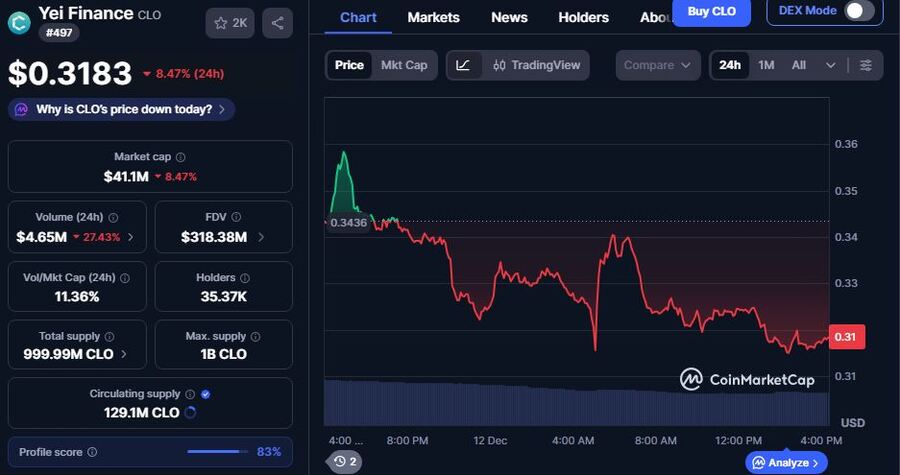
The SolvBTC token launch on the Yei Finance platform is more than just an integration. Yei Finance (CLO) is one of the rapidly growing decentralized liquidity protocols that allow users to hold their tokens, enabling them to perform several financial operations (like lending, borrowing, swapping, staking, and others) across different DeFi networks. Its TVL, which currently stands at (according to DeFillama), reflects the rising popularity of the protocol in the DeFi landscape. Despite the integration, the price of CLO has not moved much, currently trading at $0.3183, down 7.5% over the past 24 hours.
Powered by its native token (CLO), Yei Finance (also commonly known as Clovis) functions as a cross-chain liquidity platform that aims to unify fragmented funds across DeFi. In a decentralized finance landscape that is often divided by closed networks and liquidity pools, Yei runs a unified clearing and settlement platform that connects numerous blockchain networks like Ethereum, SEI, BNB Chain, and several others. Through this approach, Clovis allows crypto users to lend, exchange, move, and trade assets from a unified pool of liquidity rather than moving applications on fragmented networks across DeFi ecosystems.
With the integration of SolvBTC on the platform, Yei enables its users to put their Bitcoin tokens to work and unlock full BTC’s potential in DeFi.
Disclaimer: The content of this article solely reflects the author's opinion and does not represent the platform in any capacity. This article is not intended to serve as a reference for making investment decisions.
You may also like
The Transformation of Education Through AI: Key Investment Prospects in EdTech and STEM Education
- AI in education market to surge from $7.05B in 2025 to $112.3B by 2034 at 36.02% CAGR, per Precedence Research. - Asia-Pacific leads growth at 46.12% CAGR; corporate e-learning to hit $44.6B by 2028 with 57% efficiency boost. - AI edtech startups raised $89.4B in Q3 2025 (34% of VC), with infrastructure investments at 51% of global deal value. - STEM institutions partner with tech giants to build AI talent pipelines, supported by $1B Google and $140M NSF investments. - Market risks include 66.4% revenue

ChainOpera AI Token Plummets 70%: A Stark Warning for AI-Based Cryptocurrencies
- ChainOpera AI (COAI) collapsed 99% in late 2025 due to hyper-centralization, governance failures, and technical vulnerabilities. - 88% token control by ten wallets, $116.8M losses at C3.ai, and minimal code updates exposed systemic risks in AI-driven crypto projects. - Regulatory uncertainty from U.S. CLARITY/GENIUS Acts and algorithmic stablecoin collapses accelerated panic, highlighting market fragility. - The crash underscores urgent need for frameworks like NIST AI RMF and EU AI Act to balance innova

The Increasing Expenses of Law School and the Expansion of Public Interest Scholarship Initiatives
- US law school tuition rose to $49,297/year by 2025, with debt averaging $140,870, driven by declining state funding and inflation. - The 2025 OBBB Act capped student loans at $50,000/year and $200,000 total, prompting schools like Santa Clara to adopt tuition moderation and scholarships. - Public interest scholarships (e.g., Berkeley, Stanford) and LRAPs now enable 85%+ retention in public service roles, reducing debt's influence on career choices. - PSLF has forgiven $4.2B for 6,100 lawyers since 2025,

The PENGU USDT Sell Alert and Its Impact on Stablecoin Market Trends
- PENGU/USDT's 2025 sell-off triggered a 30% price crash and $128M liquidity shortfall, exposing flaws in algorithmic stablecoin models. - High concentration (70.72% held by large wallets) and USDT dependency amplified volatility, eroding trust in decentralized governance. - Retail optimism clashed with institutional caution, accelerating migration to regulated stablecoins like USDC under U.S. and EU frameworks. - Regulators and institutions now prioritize hybrid models combining AI governance with CBDCs t