The Best Crypto Futures Trading Platforms for 2026 (Ranked & Reviewed)
Key Takeaways
-
Crypto futures trading remains a dominant force in the market heading into 2026, driven by demand for leverage, flexibility, and two-way trading opportunities.
-
Exchange selection matters, as liquidity, fees, execution quality, and risk controls directly impact futures trading performance.
-
The top 5 crypto futures trading platforms reviewed are Bitget, Binance, Bybit, OKX, and MEXC, each serving different trader needs.
-
Bitget stands out as the most balanced option, offering extensive futures markets, competitive fees, and accessible features such as copy trading.
What Is Crypto Futures Trading?
Crypto futures trading allows traders to speculate on the price of cryptocurrencies through derivative contracts without owning the underlying assets. Unlike spot trading, futures enable both long and short positions, giving traders the ability to profit from rising and falling markets. Most crypto futures today are perpetual contracts with no expiration date, using funding rates to keep prices aligned with the spot market, while traditional delivery futures settle at a fixed date and are used less frequently by retail participants.
The defining features of crypto futures are leverage and margin. Traders can control large positions with a relatively small amount of capital, which amplifies both potential gains and losses. For example, using 10× leverage, a trader can open a $50,000 Bitcoin futures position with $5,000 in margin. A small price movement can result in significant profit, but an adverse move can quickly lead to liquidation if margin requirements are not met. While futures trading offers efficiency and flexibility, it also introduces elevated risk, making a solid understanding of leverage, funding rates, and risk management essential for long-term success.
How to Choose the Best Crypto Exchange for Futures Trading
When evaluating crypto futures platforms, a few key factors make the biggest difference in performance and safety:
-
Liquidity and depth: High trading volume ensures tight spreads, fast execution, and minimal slippage during volatile markets.
-
Futures variety: Support for BTC, ETH, and a broad range of altcoin futures allows greater strategy flexibility.
-
Fees and funding rates: Competitive maker and taker fees, along with reasonable funding rates, help reduce long-term trading costs.
-
Leverage and margin options: Flexible leverage settings and isolated or cross margin help traders manage risk more effectively.
-
Risk management and stability: Insurance funds, liquidation protections, and reliable system uptime are critical in leveraged trading.
-
User experience and security: An intuitive interface, strong security practices, and regulatory awareness support safer, more efficient trading.
Together, these factors provide a practical framework for identifying a futures exchange that aligns with both trading style and risk tolerance.
1. Bitget
-
Futures trading pairs: 620+
-
Futures fees (maker/taker): 0.02% / 0.06%
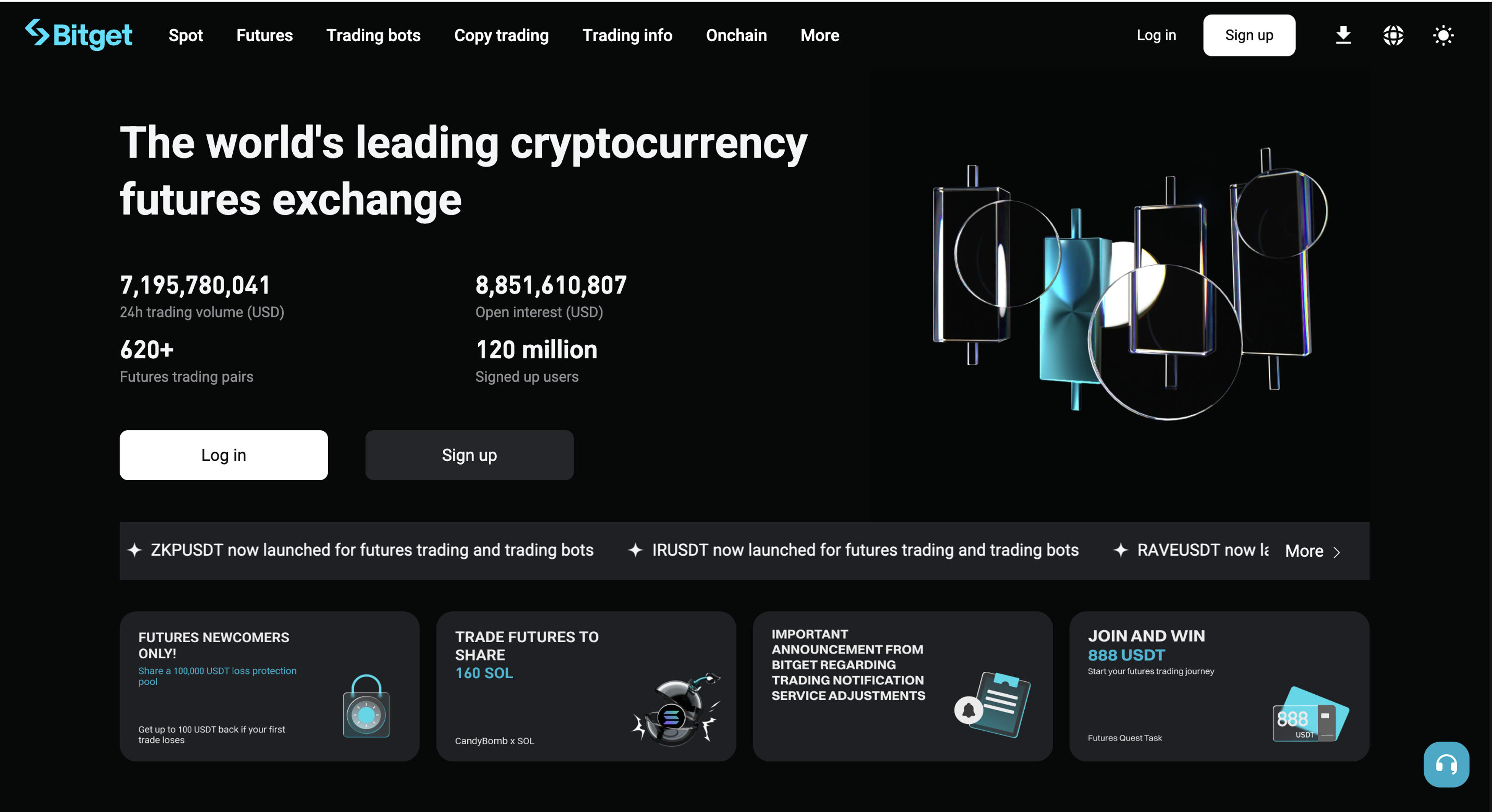
Founded in 2018, Bitget has grown into one of the largest crypto derivatives exchanges globally, serving 120 millions of users across more than 100 countries. From the outset, the platform has taken a derivatives-first approach, prioritizing futures trading infrastructure, execution reliability, and trader-oriented tools rather than treating derivatives as a secondary product.
Bitget offers one of the most expansive futures markets in the industry, with 620+ futures contracts covering major assets such as Bitcoin and Ethereum alongside a deep and regularly updated selection of altcoins. This breadth supports a wide range of trading strategies, from high-liquidity directional trades to sector rotation and short-term volatility plays. On actively traded pairs, Bitget consistently delivers strong order book depth, helping maintain tight spreads and stable execution even during periods of elevated market volatility.
The platform’s fee structure is designed with active traders in mind. Base futures fees are set at 0.02% for makers and 0.06% for takers, with additional fee reductions available through VIP tiers and the use of Bitget’s native token, BGB. These incentives can materially reduce trading costs for high-frequency and high-volume traders, improving long-term capital efficiency without sacrificing liquidity.
Bitget is also widely recognized for its copy trading ecosystem, one of the largest in the crypto derivatives space. The platform supports thousands of verified lead traders and enables users to automatically replicate futures strategies in real time. This system has attracted millions of copy trading participants, making Bitget particularly appealing to newer traders seeking exposure to futures markets while learning from experienced professionals.
From an infrastructure and risk perspective, Bitget emphasizes platform stability and transparency. The exchange reports 99.99% system uptime, employs industry-standard security measures such as cold wallet storage and multi-factor authentication, and maintains a dedicated protection fund valued in the hundreds of millions of dollars to help mitigate extreme liquidation events. Regular proof-of-reserves disclosures further reinforce user confidence in asset backing and platform solvency.
Taken together, Bitget’s scale, extensive futures coverage, competitive pricing, and differentiated social trading features position it as the best overall crypto futures trading platform for 2026. For traders seeking a balance between professional-grade functionality, cost efficiency, and accessibility, Bitget offers one of the most complete futures trading environments in the market today.
2. Binance
-
Futures trading pairs: 250+
-
Futures fees (maker/taker): 0.02% / 0.05%
Binance is widely recognized as the largest crypto derivatives exchange by trading volume, offering some of the deepest order books in the industry. Its futures platform supports a broad range of perpetual and delivery contracts across major cryptocurrencies and popular altcoins, making it a preferred venue for high-volume traders and institutions. With consistently high open interest and daily futures volume reaching tens of billions of dollars, Binance provides tight spreads and reliable execution, particularly for large orders. The platform also offers advanced order types, flexible margin settings, and extensive API support, though its complexity and regional regulatory restrictions may limit accessibility for some users.
Bitget vs. Binance
While Binance leads in overall liquidity and market depth, Bitget differentiates itself through a wider selection of futures trading pairs and a more accessible trading experience. Bitget’s copy trading ecosystem and trader-focused features make it easier for less experienced users to participate in futures markets, while still offering competitive liquidity on major pairs. For traders prioritizing sheer volume and institutional-scale execution, Binance remains a strong choice, but those seeking broader market coverage and a more user-centric futures platform may find Bitget better aligned with their needs.
3. Bybit
-
Futures trading pairs: 450+
-
Futures fees (maker/taker): 0.02% / 0.055%
Bybit has built its reputation as a derivatives-first exchange, catering primarily to active and experienced futures traders. The platform focuses heavily on perpetual contracts for major cryptocurrencies and selected altcoins, with an emphasis on fast execution, system stability, and a professional trading interface. Bybit consistently ranks among the top exchanges by futures trading volume, offering solid liquidity on major pairs and a robust set of advanced order types, margin options, and API tools. Its clean interface and performance-oriented design appeal to technically confident traders, although the platform may feel less beginner-friendly compared to more socially driven exchanges.
Bitget vs. Bybit
Both Bitget and Bybit are strong contenders in the crypto futures space, but they cater to slightly different trader profiles. Bybit excels as a streamlined, performance-focused platform for experienced derivatives traders who value execution speed and simplicity. Bitget, on the other hand, offers a broader range of futures trading pairs and stands out with its copy trading ecosystem, making it more accessible to newer traders while still supporting advanced strategies. Traders seeking a pure, professional trading environment may prefer Bybit, while those looking for greater market variety and community-driven features may find Bitget the more versatile choice.
4. OKX
-
Futures trading pairs: 200+
-
Futures fees (maker/taker): 0.02% / 0.05%
OKX is known for offering a comprehensive derivatives ecosystem tailored to advanced and professional traders. In addition to perpetual and delivery futures across major cryptocurrencies and a broad range of altcoins, OKX provides sophisticated tools such as portfolio margin, unified trading accounts, and options markets. These features make the platform well suited for complex trading strategies and capital-efficient risk management. While OKX offers strong liquidity and a wide product suite, its advanced functionality can present a steeper learning curve for less experienced traders.
Bitget vs. OKX
OKX stands out for its advanced risk management tools and institutional-style features, making it a strong choice for sophisticated traders managing complex portfolios. Bitget, by contrast, emphasizes accessibility and breadth, offering a larger number of futures trading pairs and a more intuitive trading experience. With its copy trading ecosystem and streamlined interface, Bitget appeals to a wider range of traders, particularly those seeking advanced functionality without added complexity.
5. MEXC
-
Futures trading pairs: 1,200+
-
Futures fees (maker/taker): 0.01% / 0.04%
MEXC is best known for its extensive selection of altcoin futures, often listing perpetual contracts for emerging tokens earlier than larger exchanges. The platform caters to traders seeking exposure to high-volatility markets beyond major cryptocurrencies, offering a wide range of niche and newly launched assets. MEXC’s low fee structure is particularly attractive for frequent traders, though liquidity can vary significantly across smaller contracts, making execution less consistent compared to top-tier venues.
Bitget vs. MEXC
MEXC excels in breadth, particularly for speculative altcoin futures, but Bitget offers a more balanced trading environment with stronger liquidity on actively traded pairs and more comprehensive risk management features. While MEXC appeals to traders focused on early-stage or niche markets, Bitget provides broader futures coverage alongside better execution consistency and additional tools such as copy trading, making it a more versatile option for a wider range of futures traders.
Which Crypto Futures Platform Is Right for You?
The right crypto futures platform depends on your experience level and trading priorities. Most traders will find that exchanges fall into one of the following categories:
-
Beginner-friendly and accessible platforms: Bitget, Bybit, OKX
-
High-liquidity platforms for active traders: Binance, Bitget, Bybit
-
Platforms with broad altcoin futures coverage: Bitget, MEXC, OKX
Selecting a platform that aligns with your trading style, risk tolerance, and market focus can help improve execution quality and overall trading efficiency.
Conclusion
As crypto futures trading moves into its next phase in 2026, the focus has shifted from simply accessing leverage to finding platforms that offer reliability, depth, and adaptability in increasingly competitive markets. With derivatives now driving the majority of crypto trading activity, traders need exchanges that can support fast execution, effective risk management, and a wide range of strategies across different market conditions.
In this landscape, Bitget, Binance, Bybit, OKX, and MEXC each play a distinct role. Bitget distinguishes itself through a well-rounded futures ecosystem that blends broad market coverage with accessible tools like copy trading. Binance continues to set the standard for liquidity, Bybit caters to performance-driven traders, OKX supports sophisticated risk management and advanced strategies, and MEXC offers unmatched exposure to emerging altcoin futures. By understanding these strengths and choosing a platform that aligns with individual goals, traders can approach crypto futures markets with greater confidence and clarity in the year ahead.
Disclaimer: The opinions expressed in this article are for informational purposes only. This article does not constitute an endorsement of any of the products and services discussed or investment, financial, or trading advice. Qualified professionals should be consulted prior to making financial decisions.